
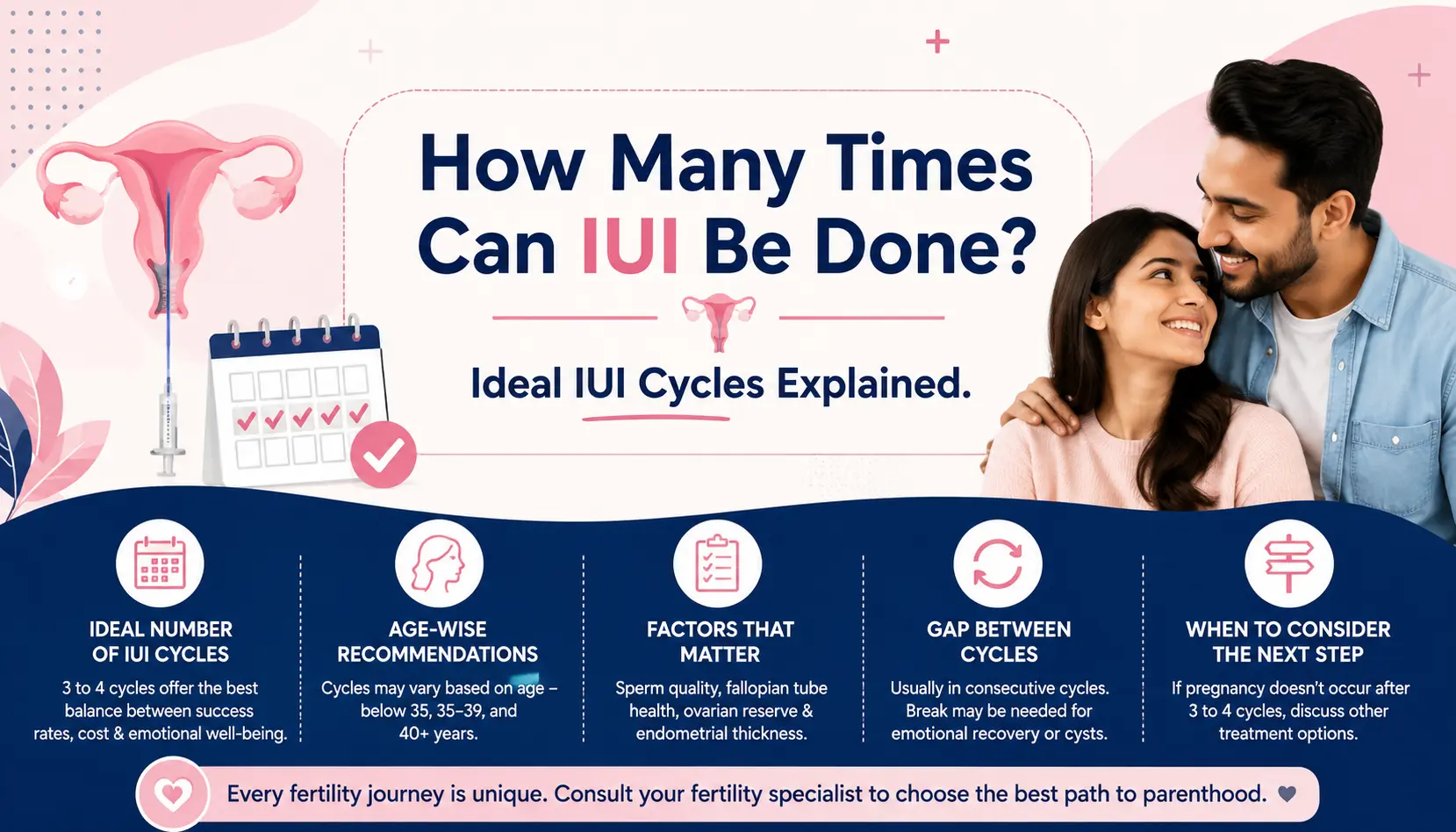
If you’re planning to undergo Intrauterine Insemination (IUI), one of the most common questions you may have is: “How many times can IUI be done?” The answer isn’t the same for everyone. The ideal number of IUI attempts depends on several factors, including age, fertility health, ovarian reserve, sperm quality, and previous treatment outcomes. However, medical experts generally agree that 3 to 4 IUI cycles offer the best balance between success rates, treatment costs, and emotional well-being.
Understanding when to continue with IUI and when to consider another fertility treatment can help couples make informed decisions without unnecessary delays or repeated unsuccessful cycles.
What Is the Ideal Number of IUI Cycles?
Research shows that 3 to 4 IUI cycles are considered the most effective treatment window for most couples.
During the first IUI cycle, the chance of achieving pregnancy is generally around 10–15%. However, as the treatment continues, the chances improve because the success rate becomes cumulative. By completing 3 to 4 cycles, the overall probability of pregnancy can increase to approximately 35–40%.
After the fourth cycle, however, the success curve begins to level off. This means that additional IUI attempts beyond four cycles may not significantly improve the likelihood of pregnancy, while the financial cost and emotional stress continue to increase. For many couples, this becomes the point where discussing alternative fertility treatments with a specialist is appropriate.
Does Age Affect How Many Times IUI Should Be Tried?
Yes. A woman’s age plays an important role in determining how many IUI cycles are reasonable before moving to another treatment option.
Women Below 35 Years
Women under 35 generally have better egg quality and ovarian reserve. Because of this, fertility specialists may recommend 3 to 6 IUI cycles, depending on the couple’s overall fertility condition and response to treatment.
Women Between 35 and 39 Years
For women between 35 and 39 years of age, fertility naturally begins to decline. In this age group, up to 3 IUI cycles are usually considered appropriate. Delaying further treatment after repeated unsuccessful attempts may reduce the chances of pregnancy due to declining egg quality.
Women Aged 40 Years and Above
After the age of 40, IUI success rates become considerably lower. In many cases, only 1 or 2 IUI attempts may be considered before evaluating whether another fertility treatment would be more suitable.
What Factors Decide Whether You Should Continue IUI?
The number of IUI attempts is not based on age alone. Fertility specialists also evaluate several medical factors before recommending whether to continue treatment.
Sperm Count and Motility
IUI works best when the processed sperm sample has an adequate number of healthy, motile sperm. If the sperm count or motility is significantly lower than the recommended level, repeated IUI cycles may provide limited benefit.
Fallopian Tube Health
At least one healthy and open fallopian tube is essential for IUI to work because fertilization still takes place naturally inside the body. If both tubes are blocked, IUI is not considered an effective treatment option.
Ovarian Reserve
The ovarian reserve, commonly assessed through the AMH level, helps determine how well the ovaries may respond to treatment. A good ovarian reserve may support additional IUI cycles, while a low reserve may indicate that moving to another treatment sooner could be beneficial.
Endometrial Thickness
For successful implantation, the uterine lining should be adequately developed during ovulation. A healthy endometrial lining improves the chances of embryo implantation after insemination.
How Much Gap Should There Be Between Two IUI Cycles?
In most cases, IUI can be performed in consecutive menstrual cycles. If one cycle is unsuccessful, the next cycle can usually begin after the following menstrual period without requiring a long waiting period.
READ MORE: Wondering when implantation happens after an IUI procedure and what symptoms to expect? Read our detailed guide on How Many Days After IUI Does Implantation Occur | Guide 2026.
However, a temporary break may sometimes be recommended for two reasons:
- Emotional recovery: Repeated unsuccessful treatment cycles can be emotionally challenging, and taking a short break may help couples feel mentally prepared before continuing treatment.
- Ovarian cysts: Fertility medications used during ovulation induction may occasionally lead to small ovarian cysts. In such cases, the doctor may recommend waiting for one menstrual cycle before restarting treatment.
When Should You Consider the Next Treatment Option?
Repeated unsuccessful IUI cycles do not mean that pregnancy is impossible. Instead, they may indicate that the current treatment approach is not the most suitable for your specific fertility condition.
If 3 to 4 IUI cycles have not resulted in pregnancy, it is generally the appropriate time to discuss the next step with your fertility specialist. Continuing multiple additional IUI attempts without reassessing the treatment plan may increase emotional and financial burden without substantially improving success rates.
READ MORE: Want to understand exactly how the IUI procedure is performed, from semen preparation to insemination and post-treatment care? Read our complete guide on How Is IUI Treatment Done | Step-by-Step Guide Explained FAQ
How SurrogacyFertility Can Support Your Fertility Journey
Choosing the right fertility treatment can be overwhelming, especially when deciding whether to continue with IUI or consider another option. SurrogacyFertility is a consultation platform that helps families connect with verified fertility specialists and ART-registered clinics based on their medical condition, budget, and treatment requirements. The team provides transparent guidance, clinic matching, treatment planning support, and ongoing assistance throughout the fertility journey, helping intended parents make informed decisions with confidence.
Final Thoughts
For most couples, 3 to 4 IUI cycles represent the ideal treatment duration because they provide the highest cumulative success while avoiding unnecessary delays and repeated unsuccessful attempts. The exact number of cycles, however, should always be based on individual factors such as age, sperm quality, ovarian reserve, fallopian tube health, and overall fertility evaluation. Rather than focusing only on the number of attempts, the goal should be to follow a treatment plan that offers the best opportunity for achieving a healthy pregnancy while balancing time, emotional well-being, and treatment effectiveness.
Frequently Asked Questions (FAQs)
Most fertility specialists recommend 3 to 4 IUI cycles because this offers the best balance between cumulative pregnancy success, treatment cost, and emotional well-being. If pregnancy does not occur after these attempts, it is generally advisable to discuss alternative fertility treatment options with a fertility specialist.
Yes. Age is one of the most important factors in deciding how many IUI cycles to attempt. Women under 35 may try 3–6 cycles, those aged 35–39 are generally advised to undergo up to 3 cycles, while women aged 40 and above may be recommended 1–2 cycles before reassessing treatment options.
The decision to continue IUI depends on several fertility factors, including sperm count and motility, fallopian tube health, ovarian reserve (AMH level), and endometrial thickness. These medical factors help fertility specialists evaluate whether additional IUI cycles are likely to improve the chances of pregnancy.
Yes. In most cases, IUI can be performed in back-to-back menstrual cycles if the previous attempt was unsuccessful. However, a short break may be recommended if emotional stress becomes significant or if ovarian cysts develop after ovulation induction medications.
If 3 to 4 IUI cycles do not result in pregnancy, it is generally the right time to review your fertility treatment plan. Multiple unsuccessful IUI attempts may indicate that another treatment approach could be more appropriate based on your individual fertility condition and medical evaluation.