Infertility can be an emotional journey, and understanding the available treatment options is often the first step toward making informed decisions. Two of the most common fertility treatments are Intrauterine Insemination (IUI) and In Vitro Fertilization (IVF). While both are part of Assisted Reproductive Technology (ART), they differ significantly in how they work, who they are suitable for, their complexity, cost, and expected success rates.
If you’re wondering “Which treatment is right for me: IUI or IVF?”, this guide explains the differences in a simple and easy-to-understand way.
What Is the Difference Between IUI and IVF?
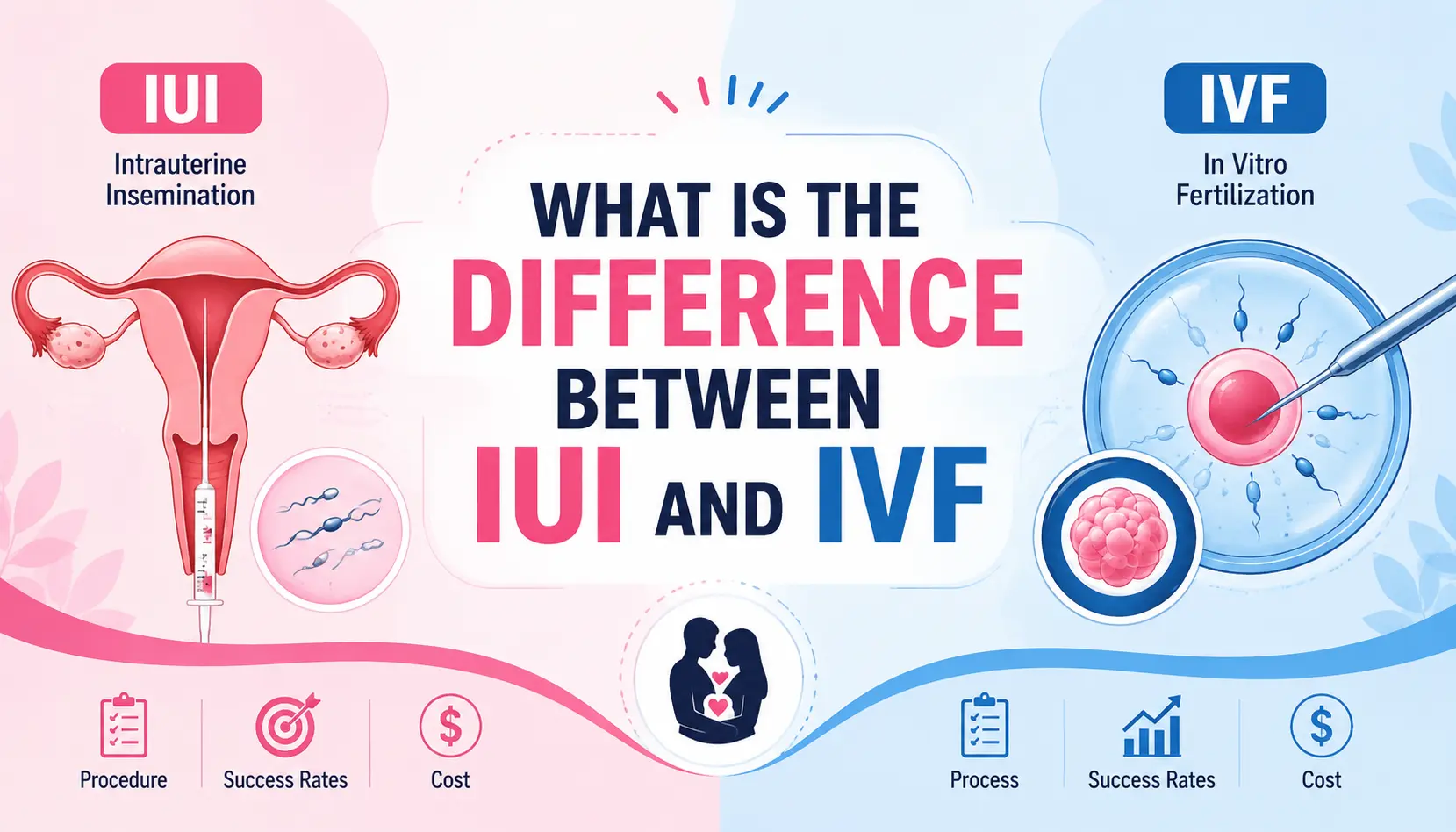
The biggest difference between IUI and IVF is where fertilization takes place.
- IUI: Fertilization happens naturally inside the woman’s body after specially prepared sperm are placed directly into the uterus.
- IVF: Fertilization takes place in a laboratory, where eggs and sperm are combined to create embryos before transferring one into the uterus.
Although both treatments aim to help couples achieve pregnancy, they are recommended for different fertility conditions.
If you’re wondering “Which treatment is right for me: IUI or IVF?”, this guide explains the differences in a simple and easy-to-understand way.
Understanding IUI and IVF with a Simple Example
Imagine sperm must complete a long journey to reach an egg.
IUI: Giving Sperm a Head Start
Think of IUI as giving healthy sperm a shortcut. Instead of traveling the entire reproductive tract, specially prepared sperm are placed directly into the uterus. From there, they still need to swim naturally to the fallopian tube and fertilize the egg on their own.
The body completes the remaining steps naturally.
IVF: Fertilization Before Transfer
IVF takes a different approach. Instead of waiting for sperm and egg to meet naturally, eggs are collected from the ovaries and fertilized with sperm in a laboratory. Once healthy embryos develop, they are transferred into the uterus.
This allows fertilization to occur outside the body before pregnancy begins.
How Does IUI Work?
IUI is a minimally invasive fertility procedure.
The process generally involves:
- Monitoring ovulation
- Collecting and preparing healthy sperm
- Placing the processed sperm directly inside the uterus
- Allowing fertilization to occur naturally within the fallopian tube
Because fertilization still depends on the sperm reaching the egg naturally, at least one fallopian tube should be open for IUI to be considered.
How Does IVF Work?
IVF involves several additional steps compared to IUI.
The treatment generally includes:
- Ovarian stimulation
- Egg retrieval
- Laboratory fertilization
- Embryo development
- Embryo transfer into the uterus
Since fertilization occurs in the laboratory, IVF can help overcome several fertility challenges that cannot be addressed through IUI.
IUI vs IVF: Key Differences
| Feature | IUI | IVF |
|---|---|---|
| Fertilization Location | Inside the body (fallopian tubes) | Outside the body (laboratory) |
| Procedure Complexity | Simple, minimally invasive | More advanced with egg retrieval |
| Fallopian Tubes | At least one tube should be open | Can be performed even if tubes are blocked |
| Treatment Duration | Usually completed within one cycle and a few clinic visits | Typically takes several weeks for one treatment cycle |
| Fertilization Control | Natural fertilization after insemination | Fertilization is performed under laboratory conditions |
Success Rates: IUI vs IVF
Success rates vary depending on several factors, including age and overall reproductive health.
According to the source material:
IUI
- Approximately 10%–20% success per treatment cycle
- Often considered an initial treatment option in suitable cases
IVF
- Approximately 40%–60% success per treatment cycle, depending on age and health factors
- Generally offers higher success because fertilization occurs under controlled laboratory conditions
It’s important to remember that fertility treatment outcomes differ for every individual, and no treatment can guarantee pregnancy.
When Is IUI Recommended?
Healthcare professionals may recommend IUI in situations such as:
- Mildly reduced sperm count or sperm motility
- Unexplained infertility
- Cervical mucus problems that prevent sperm from reaching the egg
- Cases where at least one fallopian tube is open
Because the procedure is less invasive, it is often considered before moving to more advanced fertility treatments.
When Is IVF Recommended?
IVF may be suggested when fertility challenges are more complex, including:
- Both fallopian tubes are blocked or damaged
- Severe male infertility
- Severe endometriosis
- Certain cases involving PCOS
- Multiple unsuccessful IUI cycles
- Advanced maternal age
Since fertilization occurs outside the body, IVF can overcome several barriers that may prevent natural fertilization.
Which Treatment Is Better: IUI or IVF?
Neither treatment is universally better.
The right option depends on:
- The underlying cause of infertility
- Female reproductive health
- Male fertility factors
- Previous fertility treatment history
- Age
- Medical recommendations
Some couples achieve pregnancy through IUI, while others may benefit more from IVF based on their individual circumstances.
Choosing the Right Fertility Treatment
Every fertility journey is unique. Understanding the differences between IUI and IVF can help you have more informed discussions with fertility specialists and make decisions based on your medical condition rather than assumptions.
Rather than focusing only on treatment success rates, it’s equally important to consider your diagnosis, medical history, and the treatment approach recommended for your specific situation.
How the Right Guidance Can Help
Choosing between IUI and IVF can feel overwhelming, especially when treatment options, costs, and eligibility differ from one case to another.
At SurrogacyFertility, our role is to simplify that journey. We connect intended parents with verified ART-registered fertility clinics, explain available treatment options in clear language, and help families understand the next steps based on their unique medical needs. We also provide transparent guidance and ongoing support throughout the fertility journey—completely free of consultation charges. This approach aligns with our commitment to providing honest, unbiased information and helping families make confident decisions.
Final Thoughts
Both IUI and IVF are established fertility treatments, but they are designed for different medical situations. Understanding how each procedure works, when it is recommended, and how they differ can help you make informed decisions alongside your fertility specialist.
If you’re unsure which treatment may be appropriate for your situation, seeking professional guidance can provide clarity and help you move forward with confidence.
Frequently Asked Questions (FAQs)
The primary difference between IUI (Intrauterine Insemination) and IVF (In Vitro Fertilization) is where fertilization occurs. In IUI, fertilization happens naturally inside the woman's body after processed sperm are placed into the uterus. In IVF, eggs and sperm are fertilized in a laboratory, and the resulting embryo is then transferred into the uterus.
According to the provided content, IVF generally has a higher success rate than IUI. IUI has an approximate success rate of 10%–20% per treatment cycle, while IVF offers an approximate 40%–60% success rate per cycle, depending on factors such as age and overall reproductive health.
IUI is commonly recommended for couples with mild male infertility, unexplained infertility, cervical mucus issues, or slightly reduced sperm count or motility, provided at least one fallopian tube is open. It is a simpler, minimally invasive fertility treatment that allows fertilization to occur naturally inside the body.
IVF is generally recommended for more complex fertility conditions, including blocked or damaged fallopian tubes, severe male infertility, severe endometriosis, PCOS, multiple failed IUI cycles, or advanced maternal age. Since fertilization occurs in a laboratory, IVF can overcome several natural barriers to conception.
Choosing between IUI and IVF depends on the underlying cause of infertility, age, reproductive health, previous treatment history, and medical evaluation. A fertility specialist can recommend the most appropriate treatment after assessing the couple's specific condition, helping improve the chances of a successful pregnancy through a personalized treatment plan.