
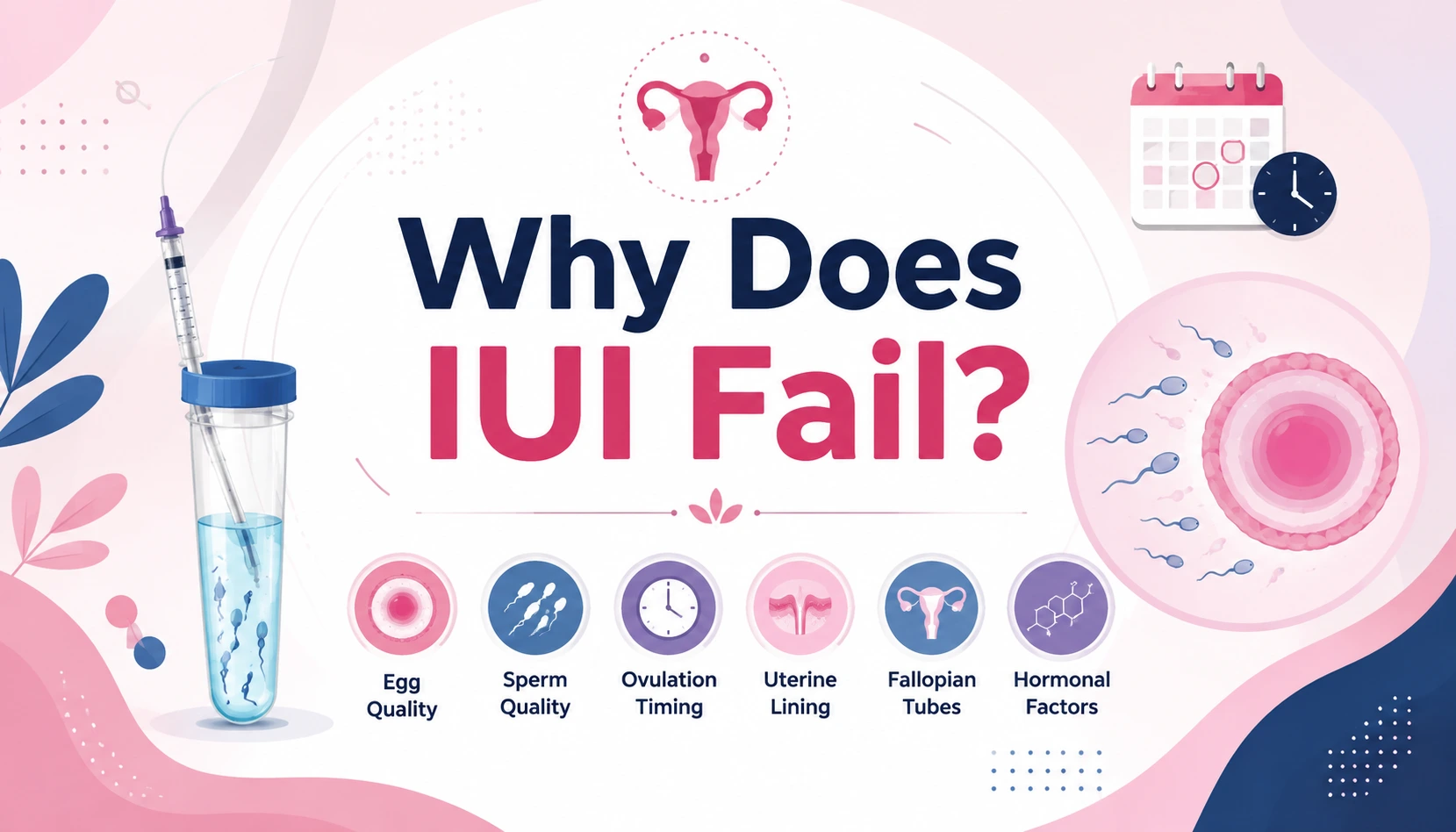
Intrauterine Insemination (IUI) is a commonly used fertility treatment in which healthy, prepared sperm is placed directly inside the uterus to help it reach the egg more easily. Although IUI can support conception, it does not guarantee pregnancy. In many cases, couples may experience an unsuccessful IUI cycle even when the treatment appears to have been performed correctly.
READ MORE : How Is IUI Treatment Done | Step-by-Step Guide Explained FAQ
The average IUI success rate per cycle is generally around 10% to 20%, which means that unsuccessful attempts are not unusual. When IUI fails, several biological and treatment-related factors may be responsible. Understanding these factors can help couples discuss the next steps with their fertility specialist and determine whether another IUI attempt or a different fertility treatment may be more appropriate.
Start Your Journey Toward Parenthood Today
Our specialists are here to guide you with compassion, expertise, and personalized care every step of the way.
Why Does IUI Fail?
IUI can fail because of factors involving egg quality, sperm quality, ovulation timing, uterine lining, fallopian tube function, or hormonal support after ovulation. Sometimes, more than one factor may contribute to an unsuccessful cycle.
1. Poor Egg Quality and Female Age
Egg quality plays an important role in IUI success. IUI helps sperm reach the egg, but it cannot improve the underlying quality of the egg.
As female age increases, particularly after the age of 35, both egg quantity and quality can decline. A lower-quality egg may contain chromosomal abnormalities. Even if fertilization occurs, the resulting embryo may not develop normally and may stop growing at an early stage.
This is why age and ovarian factors are important considerations when evaluating repeated IUI failure.
2. Low Sperm Count, Poor Motility, or Sperm DNA Damage
During IUI, sperm is processed and washed in the laboratory so that better-quality, motile sperm can be selected. However, sperm-related problems can still affect the outcome.
One important factor is the post-wash total motile sperm count (TMSC). According to the provided clinical discussion, having around 10 million active sperm after washing is considered important for IUI success, while a count below 5 million may be associated with a higher chance of failure.
Sperm DNA fragmentation can also affect fertility outcomes. A sperm may appear normal under examination while still having damaged DNA. Such sperm may fertilize an egg, but the resulting embryo may have difficulty developing or implanting successfully.
Therefore, repeated IUI failure may require a closer evaluation of sperm count, motility, and other sperm-quality factors.
3. Incorrect Ovulation or Insemination Timing
Timing is one of the most important parts of an IUI cycle.
After ovulation, the egg remains viable for only about 12 to 24 hours. This creates a relatively short window in which fertilization can occur. If insemination takes place too early or too late, the sperm and egg may not meet at the right time.
In stimulated IUI cycles, a trigger injection such as hCG may be used to help coordinate ovulation. The timing of the insemination procedure in relation to this trigger is therefore important.
Another possible issue is Luteinized Unruptured Follicle (LUF) syndrome. In this situation, an ultrasound may show a mature follicle, but the follicle does not actually rupture and release the egg. As a result, fertilization may not occur even though the follicle appeared ready.
4. Uterine Lining and Implantation Problems
Successful conception involves more than sperm meeting an egg. After fertilization, the resulting embryo must successfully implant in the uterus.
The condition of the endometrium, or uterine lining, is therefore another important factor. The source material identifies a lining thickness of approximately 7 mm to 12 mm, along with an appropriate triple-line pattern, as favorable conditions for implantation.
If the uterine lining remains too thin because of medication-related or hormonal factors, the embryo may have difficulty attaching to the uterine wall. Even when fertilization has occurred, implantation may therefore fail.
This explains why an IUI cycle can be unsuccessful even when ovulation and sperm preparation appear satisfactory.
5. Problems With the Fallopian Tubes
At least one open fallopian tube is needed for IUI. Testing such as an HSG can help determine whether the tubes are open.
However, simply having an open tube does not necessarily mean that its internal function is completely normal.
The fallopian tubes contain tiny hair-like structures called cilia, which help move the egg and sperm through the reproductive tract. Previous infections, including conditions such as tuberculosis or pelvic inflammatory disease, may damage these structures or create an unfavorable environment inside the tube.
There may also be hidden blockage or fluid that affects the reproductive process even when a tube appears open during testing.
For this reason, tubal evaluation can be an important part of understanding repeated IUI failure.
6. Hormonal Imbalance and Progesterone Deficiency
Hormonal support after ovulation is also important for maintaining a pregnancy.
Progesterone helps prepare and support the uterine environment after ovulation. If the ovaries do not produce sufficient progesterone after ovulation, a condition sometimes described as a luteal phase defect may affect the uterus’s ability to support an early pregnancy.
In such cases, pregnancy may not continue successfully and menstruation may occur.
Therefore, when IUI fails repeatedly, hormonal factors may also need to be discussed with a fertility specialist.
What Should You Do After a Failed IUI?
One failed IUI does not mean that pregnancy is impossible. IUI has a relatively limited success rate per cycle, so an unsuccessful attempt can occur even when there is no single obvious problem.
After an unsuccessful cycle, it can be useful to discuss the treatment details with a fertility specialist. Important factors to review may include:
- Post-wash sperm count and motility
- Egg and follicle development
- Timing of ovulation and insemination
- Uterine lining thickness and pattern
- Fallopian tube condition
- Hormonal support after ovulation
- The number of previous IUI attempts
- Age and overall fertility circumstances
A detailed review can help determine whether another IUI attempt is reasonable or whether a different treatment approach should be considered.
How Many Times Should You Try IUI?
According to the source material, the greatest potential for IUI success is generally seen within the first three attempts. After approximately three to four unsuccessful IUI cycles, simply repeating the same approach may not significantly improve the chances of success.
READ MORE : How Many Times Can IUI Be Done? Ideal IUI Cycles Explained
The appropriate number of attempts can vary depending on the individual situation. However, repeated failure should be a reason to reassess the underlying fertility factors rather than continuing indefinitely without reviewing the treatment strategy.
Is IVF the Next Step After Failed IUI?
For couples who have experienced multiple unsuccessful IUI attempts, IVF (In Vitro Fertilization) may become an alternative treatment option.
The major difference is that IUI relies on fertilization occurring naturally inside the reproductive tract, while IVF involves fertilization taking place in a laboratory. Embryo development can then be monitored before an embryo is transferred into the uterus.
READ MORE : What Is the Difference Between IUI and IVF? Complete Guide
For this reason, IVF may be considered when repeated IUI cycles have not resulted in pregnancy or when the factors affecting fertility make IUI less suitable.
A fertility specialist can assess the individual circumstances and explain whether continuing IUI or considering IVF is more appropriate.
Start Your Journey Toward Parenthood Today
Our specialists are here to guide you with compassion, expertise, and personalized care every step of the way.
Does Failed IUI Mean You Cannot Get Pregnant?
No. A failed IUI does not mean that pregnancy is impossible.
IUI involves several biological stages, and pregnancy depends on each stage working successfully. Sperm must be suitable, ovulation must occur at the right time, the fallopian tube must function adequately, fertilization must occur, the embryo must develop, and the uterine environment must support implantation.
A problem at any of these stages can result in an unsuccessful IUI cycle.
The important point is that one unsuccessful attempt does not necessarily identify the exact reason for failure. Repeated unsuccessful cycles, however, can provide an opportunity for a more detailed evaluation and treatment review.
How Can You Get Guidance After IUI Failure?
Choosing what to do after unsuccessful IUI treatment can be confusing, particularly when couples are unsure whether to try IUI again or explore another fertility treatment.
Surrogacy Fertility provides fertility treatment consultation and helps intended parents connect with verified ART-registered fertility clinics and experienced fertility specialists. For people considering IUI in Delhi, guidance can include understanding the fertility evaluation, treatment planning, ovulation monitoring, and available treatment options.
The consultation approach is designed to make fertility treatment easier to understand, with attention to individual medical requirements, treatment options, and transparent cost guidance.
For couples who have experienced repeated IUI failure, getting an appropriate medical evaluation is an important next step. Rather than assuming that another unsuccessful cycle means the end of the fertility journey, understanding the possible reasons behind the failure can help identify a more suitable path forward.
Final Thoughts
IUI failure can happen for many reasons, including declining egg quality, sperm-related factors, incorrect ovulation timing, problems with the uterine lining, fallopian tube dysfunction, and hormonal imbalance. Because IUI success depends on several interconnected biological processes, a failure does not necessarily mean that something was done incorrectly.
If IUI has failed once, it may still be possible to consider another attempt depending on the individual situation. However, after repeated failures, it is important to review the underlying factors and discuss whether another treatment, such as IVF, may provide a more appropriate approach.
Most importantly, failed IUI does not mean that the possibility of pregnancy is over. It means that the factors affecting conception may need to be examined more carefully so that the next treatment decision can be based on a clearer understanding of the individual fertility situation.
Frequently Asked Questions (FAQs)
IUI can fail because of several factors, including poor egg quality, age-related changes, low or poor-quality sperm, sperm DNA damage, incorrect ovulation timing, problems with the uterine lining, fallopian tube dysfunction, or hormonal imbalance. Because IUI depends on several biological stages, failure can occur when one or more of these processes does not work successfully.
Repeated IUI failure may be associated with declining egg quality, inadequate sperm parameters, sperm DNA fragmentation, incorrect insemination timing, Luteinized Unruptured Follicle (LUF) syndrome, thin endometrial lining, fallopian tube problems, or insufficient progesterone after ovulation. Reviewing these factors with a fertility specialist can help determine the next treatment approach.
Yes. IUI success can be affected by sperm count, motility, and DNA quality. The source material highlights post-wash total motile sperm count (TMSC) as an important factor and notes that lower counts may be associated with higher failure rates. Sperm DNA fragmentation may also affect embryo development and implantation after fertilization.
After failed IUI, discuss the cycle with a fertility specialist and review factors such as post-wash sperm count, egg or follicle development, uterine lining, ovulation timing, fallopian tube condition, and hormonal support. After multiple unsuccessful attempts, particularly three to four failed IUI cycles, IVF may be considered as an alternative treatment option.
No. A failed IUI does not mean pregnancy is impossible. IUI has a limited success rate per cycle, and failure can result from problems at different stages of conception, including ovulation, fertilization, embryo development, or implantation. A detailed fertility evaluation can help identify potential factors and guide the next treatment decision.