
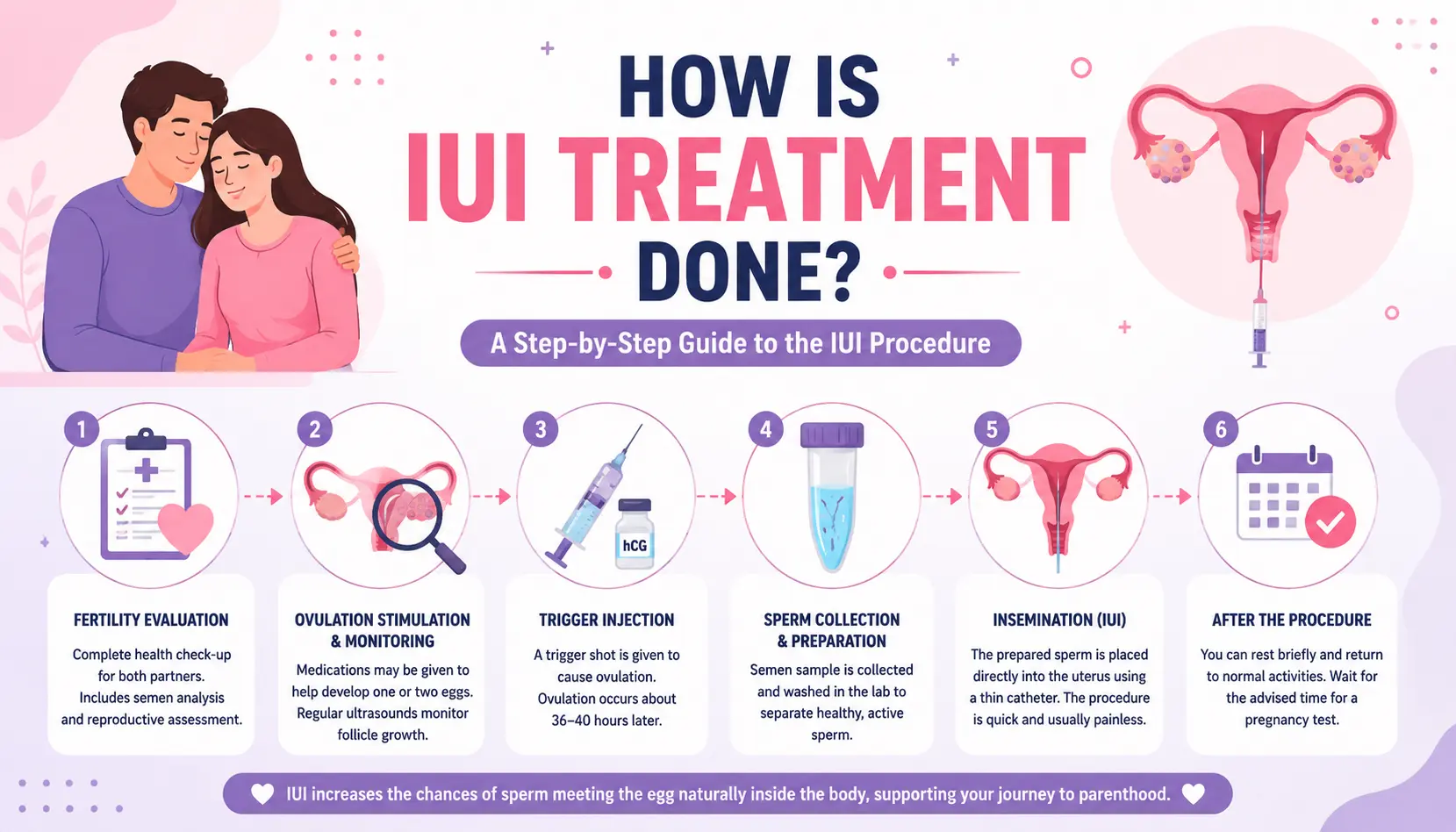
When couples experience difficulty conceiving naturally, one of the first fertility treatments that doctors may recommend is Intrauterine Insemination (IUI). Often referred to as artificial insemination, IUI is a simple, minimally invasive fertility procedure designed to improve the chances of pregnancy by helping sperm reach the egg more efficiently.
Many people considering fertility treatment have one common question: How is IUI treatment done? Understanding each stage of the procedure can help reduce anxiety and allow couples to make informed decisions about their fertility journey.
This guide explains the complete IUI treatment process in simple language, including how the procedure works, what happens before and during treatment, and who can benefit from it.
What Is IUI Treatment?
IUI, or Intrauterine Insemination, is a fertility treatment in which specially prepared sperm are placed directly inside the uterus during the woman’s fertile window. Unlike natural conception, where sperm must travel through the cervix and reproductive tract before reaching the egg, IUI shortens this journey by placing the healthiest sperm much closer to the egg.
You can think of IUI as giving sperm a “head start.” Instead of overcoming multiple natural barriers, the selected sperm are introduced directly into the uterus, increasing the likelihood that they will successfully reach and fertilize the egg.
It is important to understand that IUI does not create fertilization outside the body. Fertilization still happens naturally inside the fallopian tube after the sperm meets the egg. The procedure simply improves the chances of this meeting occurring at the right time.
How Is IUI Treatment Done? Step-by-Step Process
IUI treatment is carefully planned according to a woman’s menstrual cycle. Rather than being a single-day procedure, it involves several important stages that work together to maximize the chances of successful fertilization.
Step 1: Initial Fertility Evaluation
The first stage of IUI treatment is a detailed fertility assessment of both partners.
For the female partner, doctors examine whether the uterus is healthy and confirm that at least one fallopian tube is open. This is essential because fertilization takes place inside the fallopian tube. If both tubes are blocked, IUI is generally not considered an appropriate treatment option.
For the male partner, a semen analysis is performed to evaluate sperm count, sperm movement (motility), and overall sperm quality. These results help determine whether IUI is likely to be beneficial.
This comprehensive evaluation allows fertility specialists to understand the underlying cause of infertility and decide whether IUI is the most suitable treatment approach.
Step 2: Ovulation Stimulation and Egg Monitoring
After the initial evaluation, the next goal is to encourage healthy egg development.
Although many women naturally release one egg each month, fertility specialists may prescribe medications to stimulate the ovaries so that one or two mature eggs develop during the treatment cycle. This can improve the likelihood of successful fertilization.
Throughout this stage, regular ultrasound scans are performed to monitor the growth of ovarian follicles, which contain the developing eggs. These scans help doctors determine exactly when the eggs are approaching maturity.
Careful monitoring is one of the most important aspects of the IUI process because proper timing significantly influences treatment success.
Step 3: Trigger Injection for Ovulation
Once the leading follicle reaches an appropriate size, doctors administer a trigger injection, commonly known as the trigger shot.
The purpose of this injection is to initiate ovulation at a predictable time. Ovulation generally occurs approximately 36 to 40 hours after the injection, allowing the fertility team to schedule the insemination procedure precisely when the egg is most likely to be available for fertilization.
Since sperm and egg must meet within a limited time frame, accurate timing is one of the key factors that contributes to the effectiveness of IUI treatment.
Step 4: Sperm Collection and Preparation
On the scheduled day of insemination, a semen sample is collected from the male partner or, when appropriate, donor sperm may be used.
Before insemination, the semen undergoes a specialized laboratory process called sperm washing.
This process is an essential part of IUI because raw semen contains substances that are not suitable for direct placement inside the uterus. During sperm washing, laboratory specialists separate the healthiest, most active, and fastest-moving sperm from the remaining semen components.
By concentrating only the highest-quality sperm, the procedure helps improve the likelihood that the sperm will successfully reach the egg after insemination.
For couples who may require more advanced fertility support beyond IUI, exploring specialized reproductive care options can be highly beneficial. At Surrogacy Fertility, patients can access comprehensive fertility solutions including advanced treatments, expert consultations, and personalized care plans designed to improve the chances of conception. Whether you are just beginning your fertility journey or considering alternative options like surrogacy or assisted reproductive technologies, Surrogacy Fertility provides trusted guidance and end-to-end support to help couples achieve their dream of parenthood with confidence.
FAQs (Frequently Asked Questions)
IUI treatment involves several stages, including fertility evaluation, ovulation monitoring, egg stimulation if required, a trigger injection to time ovulation, sperm washing, and finally placing the prepared sperm directly into the uterus using a thin catheter. The procedure is carefully timed to increase the chances of fertilization.
IUI is generally considered a simple and minimally invasive fertility treatment. During the procedure, a thin catheter is used to place prepared sperm into the uterus, and most women experience only mild discomfort similar to a routine gynecological examination. The procedure usually takes just a few minutes.
Sperm washing is an essential laboratory step in IUI treatment. It separates healthy, fast-moving sperm from the semen while removing unwanted substances that are not suitable for direct placement inside the uterus. This process helps improve the quality of sperm used during insemination and supports the treatment process.
IUI treatment may be recommended for couples with unexplained infertility, mild male factor infertility, cervical mucus-related fertility issues, the need for donor sperm, or certain ejaculation-related conditions. Before treatment, doctors perform fertility assessments to determine whether IUI is an appropriate option.
After the IUI procedure, patients are typically advised to rest briefly before returning to their normal daily routine. Since fertilization occurs naturally inside the body after insemination, the following days involve waiting for implantation and the appropriate time to perform a pregnancy test as advised by the fertility specialist.
1 Comment
Why Does IUI Fail? Common Reasons For IUI Failure: Explained
August 10, 2026[…] Intrauterine Insemination (IUI) is a commonly used fertility treatment in which healthy, prepared sperm is placed directly inside the uterus to help it reach the egg more easily. Although IUI can support conception, it does not guarantee pregnancy. In many cases, couples may experience an unsuccessful IUI cycle even when the treatment appears to have been performed correctly.READ MORE : How Is IUI Treatment Done | Step-by-Step Guide Explained FAQ […]