
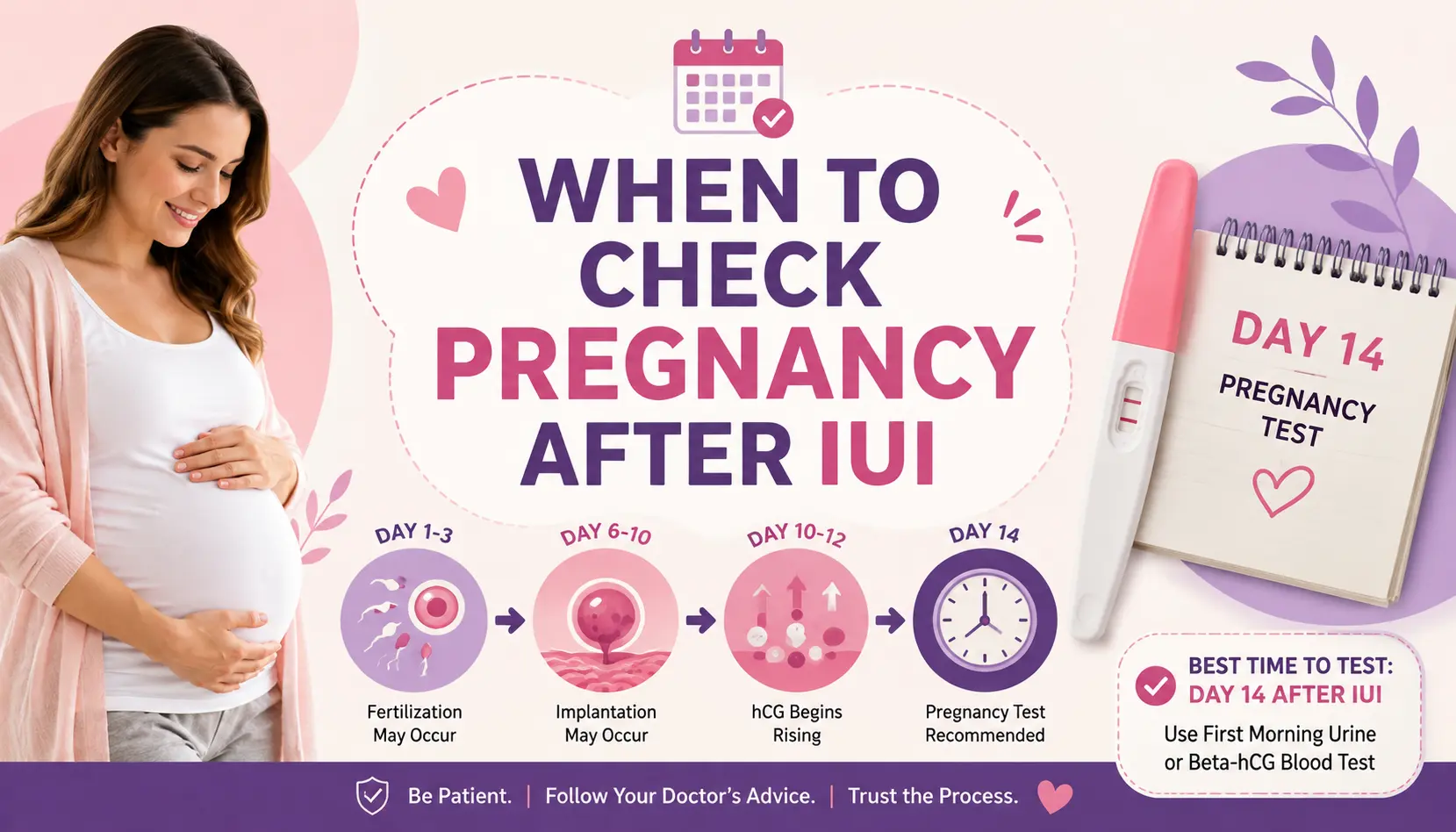
After undergoing Intrauterine Insemination (IUI), the two-week waiting period can be one of the most emotionally challenging parts of the fertility journey. A common question is, when should you check pregnancy after IUI? The recommended time to take a pregnancy test is 14 days after the IUI procedure. This period is commonly known as the Two-Week Wait (2WW). Waiting until Day 14 gives the body enough time for implantation to occur and for the pregnancy hormone, hCG (human Chorionic Gonadotropin), to rise to a detectable level.
When Should You Check Pregnancy After IUI?
The best time to check pregnancy after IUI is Day 14 after the procedure. Testing before this time may give an inaccurate result because the biological processes required for pregnancy detection are still taking place.
After IUI, sperm is placed directly into the uterus. Fertilization may occur when the sperm and egg meet. If fertilization occurs, the developing embryo travels toward the uterus and attaches to the uterine lining during a process called implantation. After implantation, the body starts producing hCG, which is the hormone detected by pregnancy tests. By around Day 14, hCG may be present at a level that can be detected through urine or blood testing.
READ MORE : How Many Days After IUI Does Implantation Occur | Guide 2026
Therefore, taking a pregnancy test on Day 14 provides a more appropriate detection window than testing during the earlier days of the two-week wait.
IUI Pregnancy Test Timeline: What Happens During the 14 Days?
Understanding the approximate timeline after IUI can help explain why waiting until Day 14 is recommended.
Days 1–3: Fertilization
During the IUI procedure, sperm is introduced directly into the uterus. The sperm and egg may meet, allowing fertilization to occur. This is the beginning of the process that may eventually lead to pregnancy.
Days 6–10: Implantation
After fertilization, the embryo travels toward the uterus and may attach to the uterine lining. This process is known as implantation.
Days 10–12: hCG Starts Rising
Once implantation occurs, the body begins producing human Chorionic Gonadotropin (hCG). This pregnancy hormone is what pregnancy tests detect.
Day 14: Pregnancy Detection Window
By Day 14, hCG may have reached a detectable level in urine or blood, making this the recommended time to check the pregnancy result.
Why Should You Avoid Testing Too Early After IUI?
Testing before Day 14 can lead to two major problems: a false-positive result or a false-negative result. These early testing problems can create unnecessary confusion and emotional stress during an already difficult waiting period.
False Positive After an hCG Trigger Shot
Some IUI cycles involve an hCG trigger shot or hCG injection to help time egg release. Because the injection contains hCG, the hormone can remain in the body after treatment and may be detected by a pregnancy test.
According to the provided source, synthetic hCG from a trigger shot may remain in the body for approximately 10–12 days. If a pregnancy test is taken too early, such as around Day 8 or Day 9, the test may detect the injected hCG rather than hCG produced as a result of pregnancy. This can lead to a false-positive pregnancy test.
This is another important reason to wait until the recommended testing window instead of relying on an early pregnancy test.
False Negative Because hCG Is Too Low
An early test can also show a negative result even when pregnancy has occurred. If implantation happens later, the body may not yet have produced enough hCG for a pregnancy test to detect.
Testing before implantation is complete or before hCG has risen sufficiently can therefore produce a false-negative result.
For this reason, an early negative test should not be used as the final answer before the recommended testing time.
Home Pregnancy Test or Beta-hCG Blood Test After IUI?
After IUI, pregnancy can be checked using either a home urine pregnancy test or a Beta-hCG blood test.
A home urine pregnancy test detects whether hCG is present in urine. The provided guidance recommends taking the test on Day 14, preferably using the first urine of the morning. This is a qualitative test, meaning it indicates whether hCG is detected rather than measuring the exact amount.
A Beta-hCG blood test, on the other hand, measures the actual level of hCG in the blood. It is recommended on Day 14 and provides a quantitative result. The provided source also notes that a doctor may repeat the blood test after 48 hours to observe whether hCG is increasing.
For this reason, visiting a clinic for a Beta-hCG blood test on Day 14 is described in the source as the most reliable way to determine the result of the IUI cycle.
What Should You Do During the Two-Week Wait After IUI?
The two-week wait can create a strong temptation to test early or interpret every physical symptom. However, the provided guidance recommends focusing on the treatment plan and waiting until the appropriate testing window.
READ MORE : What to do after IUI for success: Two-Week Wait Guide Today!
If progesterone medicines or suppositories have been prescribed, take them on time and do not skip them.
It is also important not to assume that symptoms alone can confirm pregnancy. Cramping, bloating, or light spotting may occur because of progesterone supplements or implantation, so these symptoms should not be used by themselves to determine whether the IUI was successful.
During this period, stay hydrated and continue your normal light activities. The provided guidance states that bed rest is not required.
Final Takeaway
If you are wondering when to check pregnancy after IUI, the recommended answer is Day 14 after the IUI procedure. The two-week wait gives the body time for fertilization, implantation, and the subsequent rise in hCG needed for pregnancy detection.
Testing too early can create confusion because an hCG trigger shot may contribute to a false-positive result, while later implantation may cause a false-negative result when hCG levels are still low.
On Day 14, you can use a home urine pregnancy test with first-morning urine or visit a clinic for a Beta-hCG blood test. The blood test measures the actual hCG level and is described in the provided guidance as the most reliable method for determining the IUI cycle result.
During the waiting period, continue prescribed progesterone medications on time, stay hydrated, maintain normal light activities, and avoid trying to predict the result based only on symptoms.
For families seeking fertility treatment guidance, Surrogacy Fertility provides consultation and helps connect intended parents with verified, ART-registered fertility clinics and specialists. Its fertility consultation services include guidance for treatments such as IUI, IVF, and ICSI, helping families understand their available options and treatment journey.
Frequently Asked Questions (FAQs)
The recommended time to check pregnancy after IUI is 14 days after the procedure. This two-week wait allows time for implantation and for hCG (human Chorionic Gonadotropin) to rise to detectable levels. Testing on Day 14 can be done using a home urine pregnancy test or a Beta-hCG blood test.
Testing before Day 14 after IUI may produce an inaccurate result. An hCG trigger shot can cause a false-positive result if tested too early, while later implantation may result in a false negative because hCG levels are still low. Waiting until Day 14 provides a more appropriate testing window.
A Beta-hCG blood test on Day 14 after IUI is the most reliable method described in the provided guidance. Unlike a home urine test, which gives a qualitative result, a Beta-hCG blood test measures the actual level of hCG in the blood and provides a quantitative result.
A false-positive pregnancy test after IUI can occur when an hCG trigger shot has been used before the procedure. The injected hCG may remain in the body for approximately 10–12 days and can be detected by an early pregnancy test. Testing around Day 8 or Day 9 may therefore detect the injected hormone instead of pregnancy-related hCG.
An IUI pregnancy test can be falsely negative when implantation occurs later and the body has not yet produced enough hCG for the test to detect. Testing before implantation is complete may therefore show a negative result even when pregnancy has occurred. Waiting until Day 14 after IUI is recommended.