
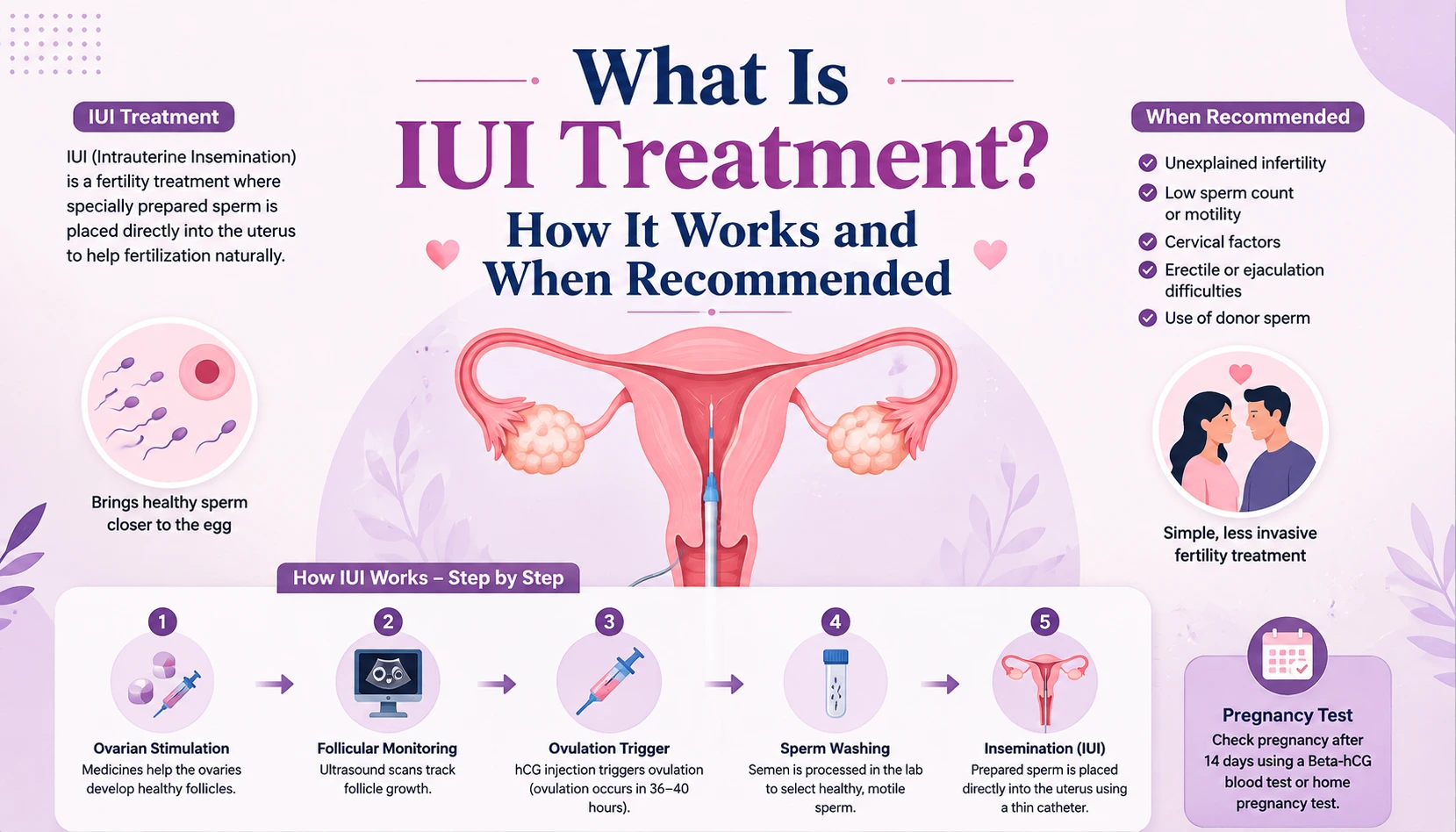
IUI treatment, or Intrauterine Insemination, is a fertility treatment that can help couples who are having difficulty conceiving naturally. In this procedure, specially prepared sperm are placed directly inside the uterus to make it easier for the sperm to reach the egg and achieve fertilization.
In a natural pregnancy, sperm have to travel from the vagina through the cervix and uterus before reaching the fallopian tubes, where fertilization generally takes place. IUI shortens this journey by placing prepared sperm directly into the uterus. This can make it easier for motile sperm to reach the area where fertilization may occur.
IUI is considered a relatively simple and less invasive fertility treatment. It may be recommended when fertility problems are relatively mild or when the exact cause of difficulty conceiving is not identified.
What Is IUI Treatment?
IUI stands for Intrauterine Insemination. It is a fertility procedure in which sperm are collected, prepared in a laboratory, and then introduced directly into the uterus using a thin catheter.
The purpose of IUI is to bring a higher concentration of healthy, motile sperm closer to the egg at the appropriate time in the menstrual cycle.
A useful way to understand IUI is to imagine that sperm normally have to travel through a long and challenging route to reach the egg. During IUI, that route is shortened by placing prepared sperm directly into the uterus. The objective is to make it easier for sperm to reach the fallopian tubes and potentially fertilize an egg.
Unlike IVF, fertilization during IUI does not take place in a laboratory. The sperm and egg are expected to meet naturally inside the reproductive tract.
When Is IUI Treatment Recommended?
IUI may be recommended when there is a relatively mild fertility problem or when routine fertility investigations do not identify a clear reason for infertility.
Some situations in which IUI may be considered include:
Unexplained Infertility
Sometimes fertility tests for both partners appear normal, but pregnancy still does not occur. This is commonly described as unexplained infertility. In such situations, IUI may be considered as a fertility treatment option.
Low Sperm Count or Reduced Sperm Motility
IUI can be considered when the male partner has a somewhat reduced sperm count or lower sperm motility. Sperm preparation allows the laboratory to separate more suitable, motile sperm for insemination.
Cervical Factors
Cervical mucus can sometimes become thick enough to make it more difficult for sperm to pass through the cervix. Because IUI places prepared sperm directly into the uterus, it can help bypass this potential barrier.
Difficulty With Intercourse or Ejaculation
IUI may also be considered when erectile difficulties or ejaculation problems make natural intercourse difficult or prevent sperm from being deposited normally.
Use of Donor Sperm
IUI may be used when a couple is using donor sperm. The prepared sperm can be introduced directly into the uterus during the appropriate part of the menstrual cycle.
How Does IUI Treatment Work?
The IUI process can be divided into four major stages: ovarian stimulation, ovulation triggering, sperm preparation, and insemination.
Step 1: Ovarian Stimulation and Egg Development
Treatment may begin around the second or third day of the menstrual period. Hormonal medicines or injections may be prescribed to help the ovaries develop suitable eggs.
The growth of the follicles is monitored through ultrasound scans, commonly referred to as follicular monitoring. The purpose of monitoring is to determine whether the egg is developing appropriately and when ovulation is likely to occur.
Step 2: Ovulation Trigger
When the developing follicle reaches the appropriate size, an hCG injection may be given to trigger ovulation.
According to the source material, ovulation generally occurs approximately 36 to 40 hours after the injection. Timing is important because IUI is planned around the expected release of the egg.
Step 3: Sperm Washing and Preparation
Around the time of ovulation, a semen sample is collected from the male partner.
The sample undergoes a laboratory process known as sperm washing. During this process, semen fluid and less suitable or non-moving sperm are removed. The objective is to isolate higher-quality, motile sperm for the insemination procedure.
This prepared sperm sample is then used for the IUI procedure.
Step 4: Insemination
The actual insemination is a short procedure.
The patient lies on a clinical examination bed, and a doctor uses a thin, flexible catheter to place the prepared sperm directly into the uterus.
The procedure generally takes around 5 to 10 minutes. According to the provided source, anesthesia is not normally required.
Because IUI does not involve surgical egg retrieval, it is considerably less invasive than procedures such as IVF.
Is IUI Treatment Painful?
IUI is described in the source material as a relatively painless procedure. The insemination itself generally takes only a few minutes, and anesthesia is not required.
READ MORE : Is IUI Painful Process? Procedure, Pain & Recovery Guide IUI
After the procedure, the patient may rest at the clinic for approximately 15 to 20 minutes. After that short period, normal daily activities can generally be resumed.
What Is the Difference Between IUI and IVF?
IUI and IVF are both fertility treatments, but they work in very different ways.
The key difference is where fertilization takes place.
With IUI, prepared sperm are placed inside the uterus, and fertilization is expected to occur naturally inside the body, generally in the fallopian tube.
With IVF, the egg and sperm are brought together outside the body in a laboratory. IVF also involves a more complex treatment process that includes egg retrieval and subsequent embryo transfer.
READ MORE : What Is the Difference Between IUI and IVF? Complete Guide
IUI is therefore generally considered simpler, faster, and less invasive than IVF. It is also described in the source as being more affordable than IVF.
The provided source gives an approximate per-cycle success range of 10%–20% for IUI and 40%–60% for IVF. However, fertility treatment outcomes can vary considerably depending on individual circumstances and treatment factors.
What Factors Affect IUI Success?
IUI success is not the same for every couple. Several factors can influence the chances of achieving pregnancy.
Age
The age of the female partner is an important consideration. The source indicates that success chances may be higher when the female partner is below 35 years of age.
Sperm Quality
The quality of the prepared sperm sample is another important factor. The number of motile sperm available after sperm washing can influence the treatment outcome.
Fallopian Tube Patency
At least one fallopian tube needs to be open and healthy because sperm and egg need to meet in the fallopian tube for fertilization to occur.
Uterine Lining
The condition and thickness of the uterine lining, or endometrium, are also relevant. A suitable uterine lining is important for an embryo to implant successfully.
Because these factors differ from one person to another, an IUI treatment plan should be based on an individual fertility evaluation rather than relying on a general success expectation.
What Should You Do After IUI Treatment?
After IUI, extended bed rest is generally not required according to the provided source.
A short period of rest at the clinic—around 15 to 20 minutes—may be sufficient before returning to normal daily activities.
However, heavy exercise, lifting heavy objects, intense gym workouts, and extreme physical stress should be avoided during the period following the procedure.
The next important stage is the waiting period before pregnancy testing.
What Are the Possible Side Effects After IUI?
IUI is generally a minimally invasive fertility procedure, but some patients may experience mild cramping or spotting afterward. These effects are usually temporary. Although complications are uncommon, patients should contact their fertility specialist if they experience significant pain, fever, or unusual vaginal discharge after the procedure.
When Can Pregnancy Be Confirmed After IUI?
The source recommends waiting approximately 14 days after the IUI procedure before confirming whether pregnancy has occurred.
Pregnancy may be checked using a Beta-hCG blood test or a home pregnancy test, depending on the medical guidance provided.
This approximately two-week period is often referred to as the two-week wait. During this time, it is important to follow the treating doctor’s instructions and avoid interpreting individual symptoms as confirmation of pregnancy.
READ MORE : What to do after IUI for success: Two-Week Wait Guide Today!
Is IUI a Suitable Fertility Treatment for Everyone?
IUI is not automatically suitable for every person experiencing infertility. Its suitability depends on factors such as the reason for infertility, sperm quality, the condition of the fallopian tubes, the uterine lining, age, and the overall fertility assessment.
For couples considering IUI, understanding the underlying fertility situation is an important first step. A fertility specialist can evaluate the available information and determine whether IUI is an appropriate option or whether another fertility treatment may be more suitable.
IUI Treatment Guidance in Delhi
For couples looking for IUI treatment in Delhi, understanding the treatment process is an important first step. Fertility consultation can help couples understand fertility evaluation, ovulation monitoring, treatment planning, sperm preparation, and the insemination procedure.
Surrogacy Fertility provides fertility treatment consultation and helps couples connect with experienced fertility specialists and verified ART-registered clinics. For IUI, the guidance can cover the initial fertility assessment, ovulation monitoring, treatment planning, and choosing a suitable fertility solution based on individual requirements.
The focus is on providing clear and transparent information so that couples can understand their treatment options without relying on unrealistic promises or guaranteed outcomes.
Conclusion
IUI treatment is a relatively simple fertility procedure that helps bring prepared, motile sperm closer to the egg by placing them directly into the uterus. The treatment commonly involves ovarian stimulation and follicular monitoring, an ovulation trigger injection, sperm washing, and intrauterine insemination.
IUI may be considered for unexplained infertility, low sperm count or reduced sperm motility, cervical factors, difficulties with intercourse or ejaculation, and the use of donor sperm. Its success can depend on several factors, including age, sperm quality, fallopian tube openness, and uterine lining condition.
Compared with IVF, IUI is less invasive because fertilization is expected to occur naturally inside the body rather than in a laboratory. For couples considering IUI, an appropriate fertility evaluation and professional treatment guidance can help determine whether this approach is suitable for their individual circumstances.
Frequently Asked Questions (FAQs)
IUI, or Intrauterine Insemination, is a fertility treatment in which specially prepared sperm are placed directly into the uterus using a thin, flexible catheter. It shortens the sperm’s journey toward the fallopian tubes and may help couples experiencing difficulty conceiving naturally.
IUI treatment generally involves ovarian stimulation, follicular monitoring, an ovulation trigger injection, sperm washing, and insemination. After suitable follicle development, ovulation is triggered, prepared motile sperm are collected, and then placed directly into the uterus around the time of ovulation.
IUI may be recommended for unexplained infertility, somewhat low sperm count or reduced sperm motility, cervical factors, erectile or ejaculation difficulties, and situations involving donor sperm. The treatment may be considered when fertility problems are relatively mild or when the exact cause of infertility is unclear.
IUI success can depend on several factors, including the female partner’s age, sperm quality, fallopian tube openness, and uterine lining condition. The provided content notes that success may be higher when the female partner is below 35 and that at least one healthy, open fallopian tube is important.
Pregnancy can generally be checked about 14 days after the IUI procedure. The provided content mentions using a Beta-hCG blood test or a home pregnancy test to confirm whether the treatment resulted in pregnancy. Extended bed rest is not required after IUI, although heavy physical activity should be avoided.