
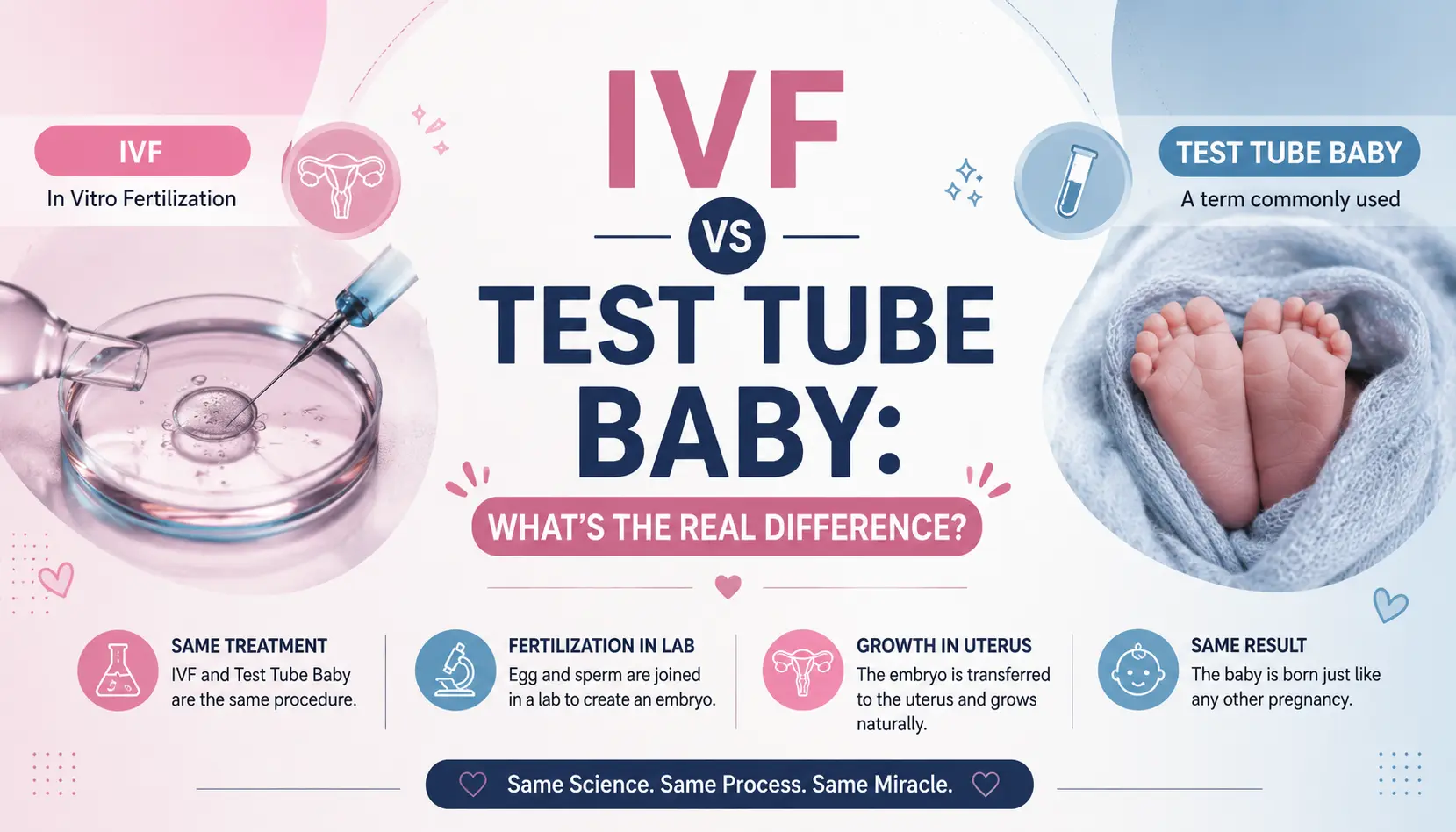
If you have ever searched for fertility treatments, you have probably come across the terms IVF and Test Tube Baby. Many people assume these are two different procedures, while others believe that a test tube baby is created and grows inside a laboratory. These misconceptions have been around for decades and continue to confuse couples exploring fertility treatment.
The truth is simple: there is no difference between IVF and a Test Tube Baby. The term “Test Tube Baby” is an informal and outdated name used by the general public, whereas IVF (In Vitro Fertilization) is the official medical term for the same treatment. Understanding this difference can help intended parents make informed decisions and avoid common myths.
READ MORE: When Do You Need IVF? Key Signs Explained– Learn the common fertility conditions, medical reasons, and signs that may indicate IVF treatment is the right option for your parenthood journey.
What Is IVF?
IVF stands for In Vitro Fertilization.
The phrase “In Vitro” means outside the human body, while “Fertilization” refers to the process where a sperm fertilizes an egg. In IVF treatment, this fertilization takes place in a carefully controlled laboratory environment before the resulting embryo is transferred into the uterus. Although the fertilization happens outside the body, the pregnancy develops naturally inside the uterus after the embryo transfer.
READ MORE: Does IVF Cause Twins? Understanding the Facts – Wondering whether IVF always leads to twin pregnancies? Learn the facts behind IVF and twins, understand what influences multiple pregnancies, and separate common myths from medical reality.
What Is a Test Tube Baby?
A Test Tube Baby is not a separate medical treatment. It simply refers to a baby conceived through the IVF process.
The phrase became popular because it was easy for people to understand when IVF was first introduced. Over time, many assumed that babies actually developed inside test tubes, which is incorrect. The baby grows in the mother’s uterus just like any naturally conceived pregnancy after the embryo is transferred.
Why Do People Think IVF and Test Tube Baby Are Different?
The confusion began when the world’s first IVF baby was born in 1978. At that time, the media used the phrase “Test Tube Baby” to explain the revolutionary treatment in simple language.
As the term became widely used, many people misunderstood the process. They believed that the entire baby was created or developed inside a laboratory test tube.
In reality, only the fertilization of the egg and sperm takes place in a controlled laboratory setting. The embryo is then placed into the uterus, where the pregnancy continues naturally.
Does IVF Use a Test Tube?
One of the biggest myths surrounding IVF is that fertilization happens inside a test tube.
This is not true.
During IVF, specialists place the egg and sperm in a Petri dish, which is a shallow laboratory dish designed for fertilization under carefully controlled conditions. The embryo is monitored for a few days before being transferred into the uterus.
Therefore, the phrase “Test Tube Baby” is simply a popular nickname and does not accurately describe the medical procedure.
How Does the IVF Process Work?
The IVF process follows a series of carefully planned steps:
1. Egg Collection
Mature eggs are collected from the female partner after medical preparation.
2. Sperm Collection
A sperm sample is obtained from the male partner or a donor, depending on the treatment plan.
3. Fertilization in the Laboratory
The egg and sperm are combined under controlled laboratory conditions to create an embryo.
4. Embryo Transfer
After several days of development, the healthy embryo is transferred into the uterus.
5. Natural Pregnancy
Once the embryo successfully implants, the pregnancy progresses naturally inside the uterus for the remaining months, just like any other pregnancy.
A Simple Example to Understand IVF
Imagine planting a seed directly into poor-quality soil. There is a chance it may not grow successfully.
Now imagine nurturing that same seed in a small nursery where it receives proper care, water, and the right environment before moving it into the field. Once the young plant is healthy, it has a much better chance of growing.
IVF follows a similar concept. The egg and sperm are first brought together in an ideal laboratory environment to form an embryo. Once the embryo is ready, it is transferred into the uterus, where the pregnancy continues naturally.
IVF vs Test Tube Baby: Comparison
| Feature | IVF | Test Tube Baby |
|---|---|---|
| Medical Status | Official scientific term | Informal public term |
| Meaning | In Vitro Fertilization | Baby conceived through IVF |
| Fertilization | Laboratory using a Petri dish | Same IVF process |
| Difference | None | None |
The comparison clearly shows that both terms describe the same fertility treatment.
Common Myth About IVF
One of the most common myths is that a baby grows inside a laboratory.
This is incorrect.
Only the fertilization of the egg and sperm takes place outside the body. Once the embryo is transferred into the uterus, the pregnancy develops naturally inside the mother’s womb.
Final Thoughts
If someone tells you that IVF and Test Tube Baby are different, they are referring to a common misconception. Both terms describe the same fertility treatment, with the only difference being the language used. IVF is the official medical name, while Test Tube Baby is an older, informal expression that became popular through public usage.
For individuals or couples exploring fertility treatment, understanding the correct terminology can make the journey less confusing and help them make informed decisions. Choosing reliable guidance and understanding the treatment process are important first steps toward parenthood.
At SurrogacyFertility, families receive transparent guidance to understand fertility treatment options and connect with verified fertility clinics based on their individual needs. The focus is on clear information, ethical practices, and supporting intended parents throughout their fertility journey with confidence.
Frequently Asked Questions (FAQs)
No. IVF (In Vitro Fertilization) and Test Tube Baby refer to the same fertility treatment. IVF is the official medical term, while Test Tube Baby is an older, informal name. Both describe the process in which fertilization occurs in a laboratory before the embryo is transferred into the uterus.
The term Test Tube Baby became popular when the first IVF baby was born because it helped explain the treatment in simple language. However, it is not a medical term. During IVF, fertilization takes place in a laboratory using a Petri dish, not inside a test tube.
No. Only the fertilization of the egg and sperm takes place in a controlled laboratory environment during IVF. After an embryo is created, it is transferred into the uterus, where the pregnancy develops naturally throughout the remaining months.
IVF involves collecting mature eggs, obtaining a sperm sample, fertilizing the egg in a laboratory to create an embryo, and transferring the embryo into the uterus. If implantation is successful, the pregnancy progresses naturally like any other pregnancy.
Yes. IVF, or In Vitro Fertilization, is the official scientific and medical term. Test Tube Baby is simply a commonly used public expression for a baby conceived through the IVF procedure. There is no medical difference between the two terms.
1 Comment
Disadvantages Of IVF Babies: What Every Parent Should Know Before Starting IVF
September 14, 2026[…] a “test tube baby” — and whether the method of conception changes any of these risks. READ MORE: IVF vs Test Tube Baby — What’s the Real Difference? Before understanding the disadvantages, it is equally important to know whether IVF is the right […]