
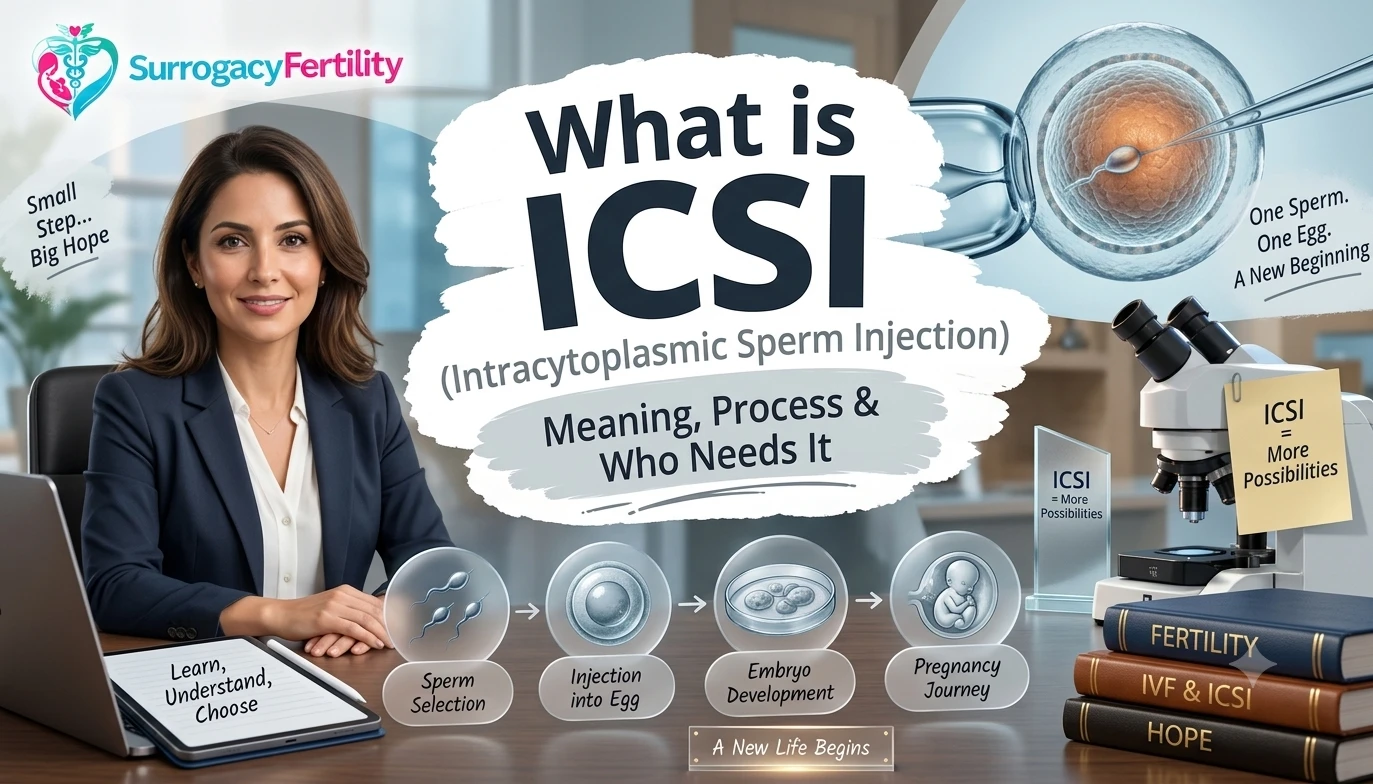
What Is ICSI?
ICSI (Intracytoplasmic Sperm Injection) is an advanced fertility treatment where a single healthy sperm is injected directly into an egg using a fine micro-needle to help fertilization happen.
- It is not a separate treatment on its own — it is an advanced step performed as part of the IVF (In Vitro Fertilization) process.
- The injection happens in a lab, under a microscope, by an embryologist (a lab specialist trained in handling eggs, sperm, and embryos).
- The goal is simple: help sperm and egg combine when this isn’t likely to happen naturally in a lab dish.
How Is ICSI Different From Traditional IVF?
The core difference comes down to how the sperm reaches the egg.
In Traditional IVF:
- The retrieved eggs and sperm are placed together in a lab dish.
- The sperm swims on its own and enters the egg naturally.
- Fertilization depends on the sperm’s own strength and movement.
In ICSI:
- The sperm is not left to enter on its own.
- An embryologist manually selects the healthiest-looking sperm.
- That sperm is injected directly into the egg’s cytoplasm (the gel-like substance inside the egg).
📖 Read More: What Is the Difference Between IVF and ICSI?
Who Needs ICSI?
ICSI is mainly recommended for male factor infertility — fertility challenges linked to sperm quality or quantity.
You may be advised ICSI if there is:
- Low sperm count — the number of sperm in the semen is much lower than normal.
- Poor sperm motility or morphology — the sperm don’t move well, or their shape/structure isn’t ideal for natural fertilization.
- Azoospermia — a condition where no sperm is present in the semen, and sperm has to be surgically extracted (through procedures like TESA or Micro-TESE) before it can be used.
Age is another factor doctors consider when recommending ICSI, alongside sperm quality.
📖 Read More: What Is the Age Limit for ICSI?
ICSI Process: Step-by-Step
Here’s what actually happens once you start an ICSI cycle, from egg retrieval to the final test.
📖 Read More: What Happens During an ICSI Cycle?
Step 1: Egg Retrieval (Ovum Pickup)
- Fertility injections are started from the second day of the woman’s period to stimulate egg growth.
- Once the eggs are ready, they are retrieved using ultrasound guidance, under light general anesthesia.
Step 2: Sperm Sample Collection
- On the same day, the male partner’s sperm sample is collected.
- This can be through a natural sample or through a surgical procedure like TESA, depending on the case.
Step 3: The Injection Process
- In the lab, the embryologist identifies the healthiest, most active sperm.
- Using a fine pipette/needle, that sperm is injected directly into the cytoplasm of the egg.
Step 4: Embryo Development & Transfer
- After fertilization, the embryo is grown in the lab for 3 to 5 days.
- Once it reaches the right stage, it is placed into the woman’s uterus (uterine cavity) using a thin catheter.
Step 5: Checking the Result
- About 14 days after the embryo transfer, a urine pregnancy test (UPT) or a blood test is done to check whether the treatment has been successful.
- Not every cycle results in a pregnancy on the first attempt — some intended parents need more than one cycle.
📖 Read More: How Many ICSI Cycles Are Needed to Get Pregnant?
Getting the Right Guidance for ICSI
Deciding whether ICSI is the right path — and finding a clinic that’s actually equipped for it — can feel confusing without the right support.
- SurrogacyFertility is a free, unbiased consultation platform (not a clinic) that connects intended parents with verified, ART-registered fertility clinics across Delhi NCR and India.
- It offers honest guidance on IVF, IUI, and ICSI, with clear cost breakdowns and no hidden charges — and no guaranteed-success claims.
- All consultation and clinic-matching support is completely free for families.
Frequently Asked Questions (FAQs)
ICSI stands for Intracytoplasmic Sperm Injection — a lab technique where a single sperm is injected directly into an egg.
No. ICSI is an advanced step within the IVF process, used specifically to assist fertilization when needed.
It's mainly recommended for male factor infertility — such as low sperm count, poor sperm motility/morphology, or azoospermia.
Azoospermia means no sperm is present in the semen. In such cases, sperm is surgically retrieved (via TESA/Micro-TESE) and then used for ICSI.
The pregnancy result can be checked about 14 days after the embryo transfer, through a urine or blood test.