
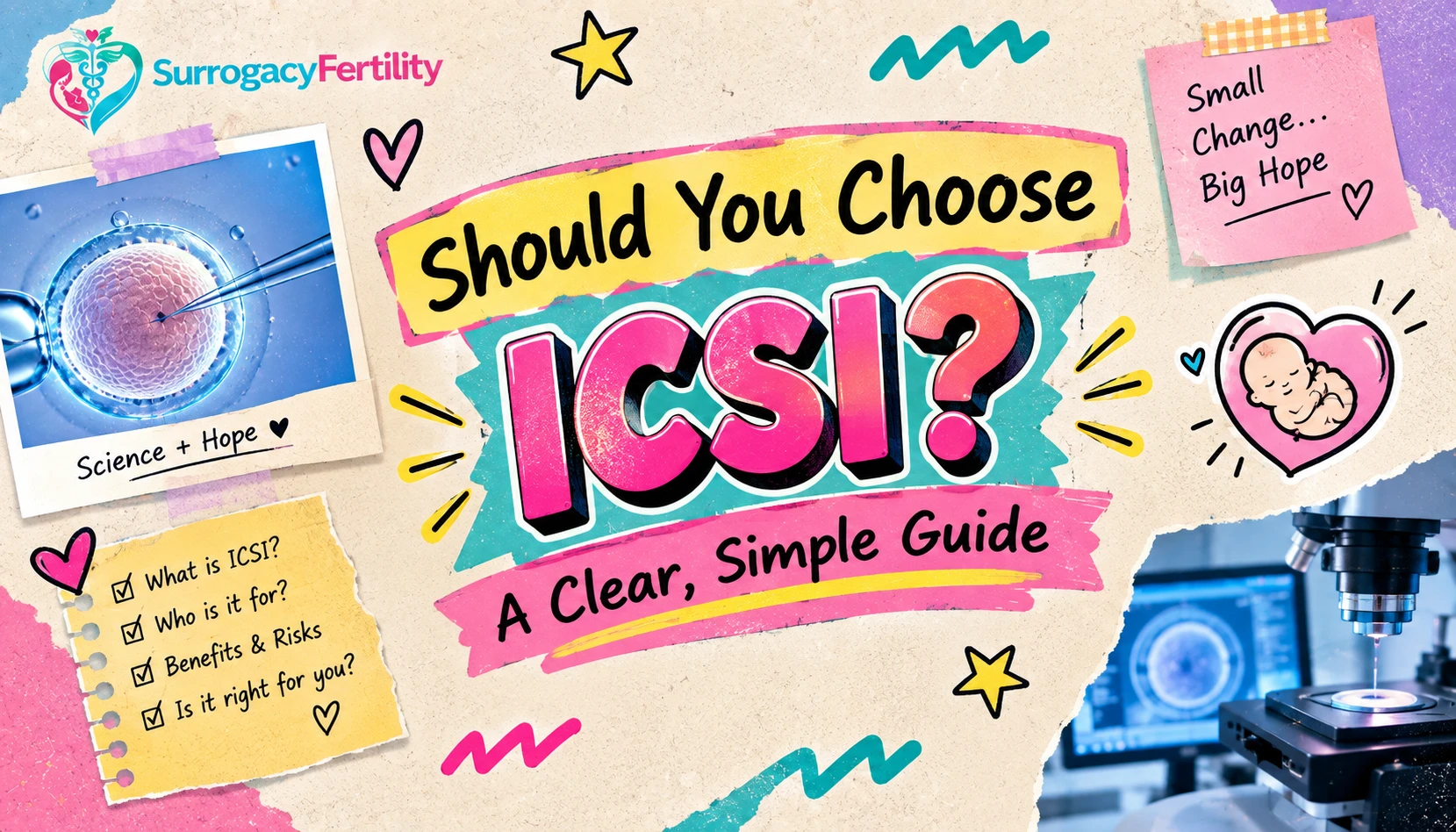
ICSI (pronounced “ixie”) is a lab technique used during IVF where a single sperm is injected directly into an egg to help it fertilize. It’s proven to help in specific situations — mainly male fertility issues — but is not automatically better for everyone, even though it’s now used far more often than the evidence supports.
What Is ICSI?
ICSI stands for Intracytoplasmic Sperm Injection. It’s a specialized form of IVF where an embryologist picks one healthy-looking sperm and injects it straight into a mature egg using a tiny needle.
- It’s different from conventional IVF insemination, where thousands of sperm are placed in a dish with the egg and left to fertilize on their own.
- ICSI removes the “waiting game” — instead of sperm having to reach and penetrate the egg naturally, the lab does it directly.
- It was first introduced in 1992 and has since become one of the most widely used techniques in fertility labs worldwide.
Read More: What Is the Difference Between IVF and ICSI?
Why Was ICSI Created in the First Place?
ICSI was developed to solve one major problem — severe male infertility that made natural fertilization very difficult or impossible.
- It gave hope to men with extremely low sperm count.
- It helped men whose sperm had poor motility (meaning the sperm couldn’t swim well enough to reach the egg).
- It made biological parenthood possible even when sperm had to be surgically retrieved (aspirated) rather than collected normally.
This is still considered ICSI’s strongest, most evidence-backed use case today.
When Does ICSI Actually Help?
Current medical evidence strongly supports ICSI in three specific situations.
- Male factor infertility — low sperm count, poor sperm movement, or abnormal sperm shape.
- Previous fertilization failure — if a couple’s eggs did not fertilize with conventional IVF before.
- Frozen (cryopreserved) eggs — frozen eggs can develop a slightly hardened outer layer, and ICSI helps bypass this barrier.
In these cases, ICSI isn’t just a preference — it meaningfully improves the chance of fertilization happening at all.
Read More: What Happens During an ICSI Cycle?
Where Is ICSI Being Overused?
ICSI has expanded well beyond its original purpose, and it’s now used in many cycles where it may not be medically necessary.
- Unexplained infertility (no clear diagnosed cause)
- Low egg yield during an IVF cycle
- Advanced maternal age
Here’s the important part: major reproductive medicine guidelines have reviewed the evidence and found that routine ICSI use in these non-male-factor situations does not significantly improve:
- Live birth rates
- Overall pregnancy outcomes
compared to conventional insemination.
Read More: What Is the Age Limit for ICSI?
Does ICSI Prevent Total Fertilization Failure?
Yes — this is one place where ICSI does add real value beyond male infertility cases.
- Total fertilization failure means none of the eggs fertilize in a cycle — a devastating outcome for intended parents.
- ICSI reduces this risk, and this benefit is especially noticeable in unexplained infertility cases.
- Even though ICSI doesn’t guarantee a higher birth rate, this “safety net” against zero fertilization is a genuine reason some doctors recommend it.
What Are the Downsides or Risks of ICSI?
ICSI is not a “risk-free upgrade.” It comes with real trade-offs that patients should know about.
- Cost and time: It adds extra lab work, which typically increases the overall cost and time of a cycle compared to conventional insemination.
- Egg handling risk: Because a needle is used to inject the egg directly, there is a small risk of egg damage during the process.
- Genetic consideration: ICSI slightly increases the chance of passing on underlying male-line genetic factors linked to infertility, since it bypasses some of the natural “selection” barriers sperm normally have to pass through.
Read More: Why Is ICSI More Expensive Than IVF?
So — Should You Choose ICSI?
There’s no universal “yes” or “no.” The right decision depends on your specific fertility profile.
- If male infertility is a diagnosed factor → ICSI is usually strongly recommended.
- If you’ve had failed fertilization before → ICSI can help prevent it happening again.
- If you’re using frozen eggs → ICSI is often the more reliable choice.
- If your infertility is unexplained, or related to egg count or age alone → ICSI may not add real benefit, and conventional insemination could work just as well.
The most reliable approach is to discuss your personal fertility profile, cost expectations, and treatment goals directly with a reproductive specialist — rather than assuming ICSI is automatically the “better” or “safer” option.
How Unbiased Guidance Can Help You Decide
Choosing between ICSI and conventional IVF insemination isn’t something that should be decided by trend or assumption — it depends on lab results, sperm analysis, egg quality, and personal medical history.
This is where getting an honest, no-pressure second opinion matters. A free consultation platform that isn’t a clinic itself can connect you with verified, ART-registered fertility clinics, help you understand clear cost breakdowns with no hidden charges, and explain treatment options — including IVF, IUI, and ICSI — in plain language before you commit to any procedure.
Frequently Asked Questions (FAQs)
ICSI (Intracytoplasmic Sperm Injection) is a specialized IVF technique where a single sperm is injected directly into a mature egg using a fine needle. Unlike conventional IVF insemination, where sperm and egg are left to fertilize naturally in a dish, ICSI directly assists fertilization, primarily for cases involving male infertility.
ICSI is strongly recommended for male factor infertility, including low sperm count or poor sperm motility, for couples with a history of failed fertilization in previous IVF cycles, and for cycles using frozen (cryopreserved) eggs. For these groups, ICSI meaningfully improves fertilization outcomes compared to conventional insemination methods.
No. ICSI does not significantly improve live birth rates for non-male-factor cases like unexplained infertility, low egg yield, or advanced maternal age, according to major reproductive medicine guidelines. Its proven benefits are concentrated in male infertility, prior fertilization failure, and frozen egg cycles specifically.
ICSI carries a small risk of egg damage during the injection process and adds extra lab time and cost compared to conventional insemination. It also slightly increases the chance of passing on male-line genetic infertility factors, since it bypasses some natural sperm-selection barriers.
Yes. ICSI reduces the risk of total fertilization failure, where none of the eggs fertilize during a cycle. This protective benefit is especially notable in unexplained infertility cases, making ICSI a valuable safety net even when it doesn't raise overall pregnancy or live birth rates.