
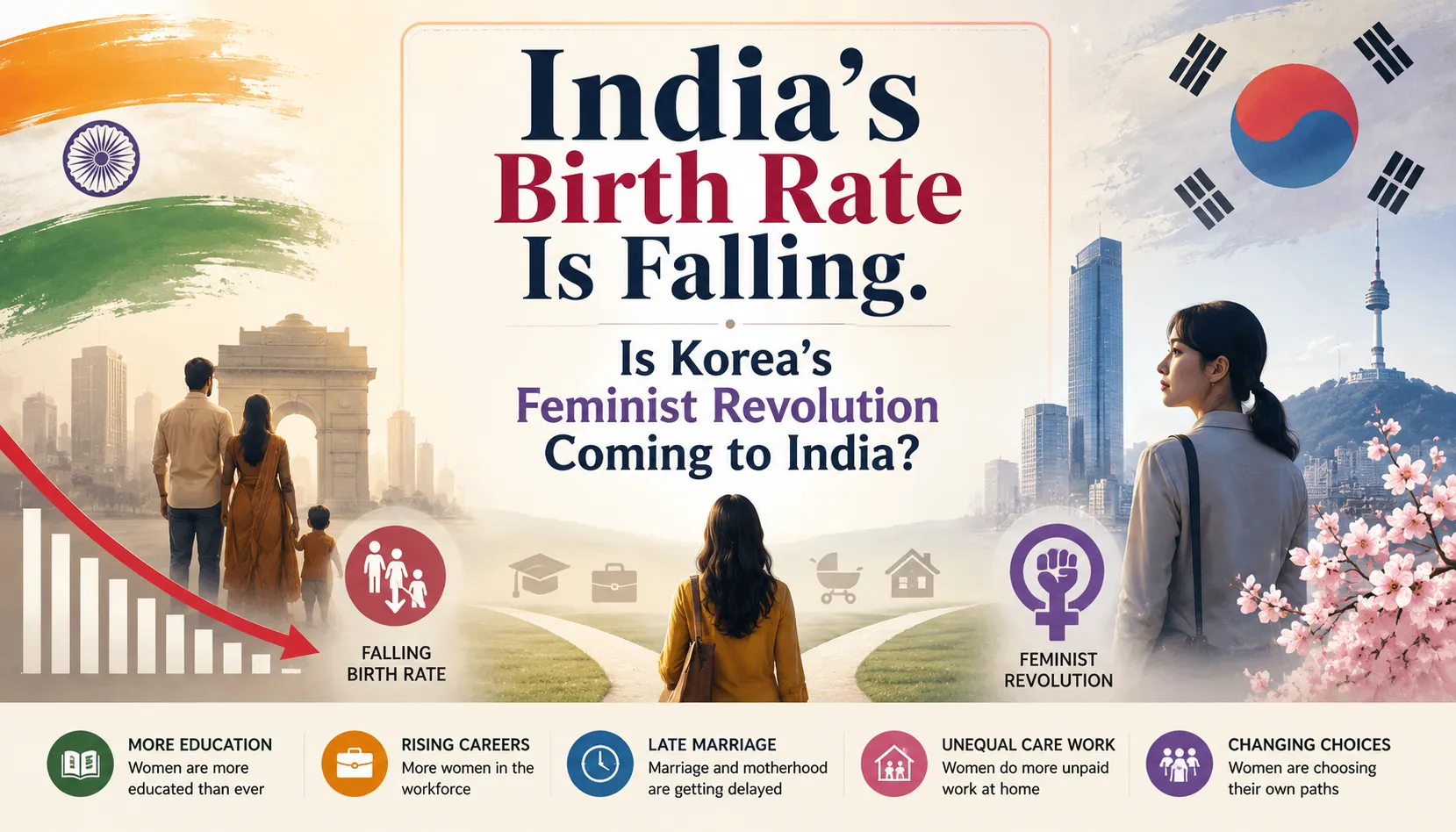
India is experiencing a major demographic shift. Fertility rates have declined, marriage is happening later, women’s education and workforce participation are increasing, and traditional expectations around family life are changing.For individuals and couples exploring different pathways to parenthood, understanding options such as Surrogacy in India can also be an important part of the wider conversation about fertility and family building.
At the same time, another question is becoming increasingly important: What happens when women’s lives change faster than households, workplaces, and social structures do?
The experience of another highly developed Asian society offers an interesting comparison. Its popular culture has become globally influential, while its fertility rate has fallen to exceptionally low levels. This does not mean India is following exactly the same path. However, some of the underlying social patterns are worth examining.
Start Your Journey Toward Parenthood Today
Our specialists are here to guide you with compassion, expertise, and personalized care every step of the way.
Is India’s Birth Rate Falling?
Yes. India’s total fertility rate (TFR) was around 1.9 in 2024, below the replacement-level fertility rate of approximately 2.1.
The difference becomes particularly clear when compared with the extremely low fertility experienced elsewhere in East Asia. A fertility rate of 1.9 does not place India in the same demographic situation, but the direction of change deserves attention.
India’s demographic transition is connected with several major social changes:
- Women are receiving more education.
- Marriage is taking place later.
- Motherhood is increasingly being postponed.
- Women’s participation in paid employment is rising.
- Individual choice is becoming more important in decisions about marriage and children.
- Urbanisation and changing cultural influences are reshaping family expectations.
These changes should not automatically be interpreted as a rejection of family life. They can also reflect greater personal freedom and more choices available to women.As family-building choices evolve, people considering surrogacy also need to understand the legal requirements that apply in India before beginning the process.
READ MORE: Is Surrogacy Banned In India? Complete Legal Guide For 2026
Why Are Women Marrying and Having Children Later?
One important factor is education.
The average age at marriage among Indian women increased from approximately 16.8 years in 1961 to 22.2 years by 2010. Research examining several decades of data has associated education, urbanisation, and mass media with increasing marriage age.
Higher education can give women greater opportunities to build careers, establish financial independence, and make decisions about marriage and motherhood on their own timelines.
For many urban and educated women, postponing motherhood is therefore not necessarily the result of a lack of interest in having children. It may be connected to completing education, establishing a career, achieving financial stability, or simply exercising personal choice.
This distinction matters.
The question is not only “Why are women having fewer children?”
It is also:
“Has society changed enough to support the choices women now have?”
Women’s Workforce Participation Is Changing
Women’s participation in India’s workforce has increased substantially. According to the discussion’s data, female workforce participation rose from approximately 24.5% in 2018–19 to 41.7% in 2023–24.
This represents a significant social transformation.
Women are increasingly participating in paid employment while also continuing to perform a large share of unpaid household responsibilities.
That creates an important tension.
A woman may now have:
- A professional responsibility.
- Household responsibilities.
- Child-care responsibilities.
- Expectations surrounding family relationships.
When these responsibilities are not redistributed, entering the workforce does not necessarily eliminate traditional domestic expectations.
Instead, another workload can simply be added.
The “Second Shift” at Home
This situation can be understood through the idea of the “second shift.”
The concept describes what happens when a person completes paid employment and then returns home to another round of unpaid domestic work and caregiving.
India’s time-use data illustrates the scale of this imbalance. Women spend substantially more time than men on unpaid domestic work and caregiving.
The discussion cites approximately 289–305 minutes of unpaid domestic and care work for women, compared with around 88 minutes for men.
This creates a fundamental problem.
Women may increasingly participate in paid employment, but the traditional distribution of household work may not change at the same speed.
As a result, employment can become an additional responsibility rather than a replacement for domestic responsibilities.For families exploring different pathways to parenthood, understanding how surrogacy works in India can provide useful context about the process involved in building a family.
READ MORE: How Surrogacy Works: Step-by-Step Process Explained In India
What Can India Learn From South Korea?
The comparison with South Korea is useful because it demonstrates what can happen when demographic and social changes interact over time.
The country has achieved extremely high levels of female education and has a highly educated female population. Yet it has also experienced extraordinarily low fertility.
One explanation highlighted in the discussion is the unequal distribution of childcare.
Among university-educated mothers with young children, women were reported to spend around 230 minutes a day on childcare, while their husbands spent only around 6 minutes.
The important lesson is not that female education causes low fertility.
Instead, the deeper issue may be a mismatch between changing expectations and unchanged responsibilities.
Women can become highly educated, enter professional careers, and gain greater economic independence. But if they are still expected to carry most domestic and childcare responsibilities, marriage and parenthood can become considerably more demanding.
Is India Becoming Like South Korea?
Not yet.
India’s fertility rate of around 1.9 remains substantially higher than the extremely low rate discussed for South Korea, around 0.8.
Therefore, it would be inaccurate to say that India is already experiencing the same demographic crisis.
However, some underlying patterns are beginning to look familiar.
India is experiencing:
- Delayed marriage.
- Delayed motherhood.
- Increasing female education.
- Rising workforce participation.
- Greater emphasis on individual choice.
- Changing relationship patterns.
- Persistent gender differences in unpaid household work.
The crucial question is whether India’s institutions and households will adapt as quickly as women’s lives are changing.
The Hidden Economic Importance of Unpaid Care Work
Domestic work and caregiving are essential to the functioning of households and the wider economy.
Cooking, cleaning, childcare, and caring for family members all require time and effort. Yet because much of this work is unpaid, it is often less visible in conventional economic measurements.
This is sometimes described as the care economy.
When women carry a disproportionate share of unpaid care work, their ability to participate fully in paid employment can be affected.
That means the issue is not simply about household fairness. It can also influence:
- Workforce participation.
- Career progression.
- Household income.
- Economic productivity.
- Decisions about marriage.
- Decisions about having children.
The discussion also connects this issue with the broader principle of equality in employment, including the constitutional objective of equal opportunities and equal pay for equal work.
Why India’s Falling Birth Rate Matters
A declining birth rate is not simply a cultural issue.
If fewer children are born over a long period, the future population structure changes.
There may eventually be:
- Fewer working-age people.
- A smaller workforce.
- A narrower tax base.
- Lower aggregate savings.
- A larger proportion of elderly people.
- Greater pressure on healthcare and pension systems.
The discussion points to declining school enrolment as an early demographic signal. Indian school enrolment reportedly reached around 25 crore students, with approximately 11 lakh fewer students in one year, and this decline was connected with the falling birth rate.
This demonstrates why fertility trends matter beyond individual families.
Does Choosing a Career Mean Rejecting Motherhood?
Not necessarily.
This is one of the most important distinctions in the entire discussion.
Women may postpone motherhood because they want to:
- Complete their education.
- Build a career.
- Become financially independent.
- Establish personal stability.
- Make their own decisions about relationships and family.
These choices represent increased personal freedom.
But if society expects women to participate in the workforce while continuing to carry most domestic and childcare responsibilities, the decision to have children may become more difficult.
Therefore, blaming women for declining fertility provides only a partial explanation.
The larger question is whether families, workplaces, and institutions are adapting to changing lives.
What Could Make Family Life More Sustainable?
The discussion points toward several possible structural changes.
1. Normalize Paternity Leave
Childcare should not automatically be considered primarily a mother’s responsibility. Greater acceptance of fathers taking parental leave could help redistribute caregiving.
2. Expand Affordable Childcare
Accessible and affordable childcare can make it easier for parents, particularly working mothers, to remain connected to employment.
3. Encourage Flexible Work
Flexible working arrangements may help parents manage professional and family responsibilities more realistically.
4. Share Domestic Responsibilities
Household work should increasingly be treated as a shared responsibility rather than an automatic obligation assigned primarily to women.
5. Provide Better Information and Support
Families need practical information about fertility, reproductive options, treatment pathways, and the realities of parenthood.
For people facing fertility challenges, professional fertility guidance can also help them understand available options without relying on exaggerated promises or misleading success claims.
Where Fertility Support Fits Into This Changing Landscape
Changing fertility patterns also mean that some individuals and couples may need medical assistance when they decide to pursue parenthood.
For families exploring fertility treatment, choosing the right specialist and understanding the available options can be confusing.
A consultation platform such as SurrogacyFertility can help intended parents understand their options and connect with verified ART-registered fertility clinics.
Its approach is based on transparent information, unbiased clinic matching, legal clarity, and understanding each family’s individual circumstances. The platform provides guidance for treatments such as IVF, IUI, ICSI, male infertility care, and legally compliant surrogacy pathways in India.
The purpose is not to pressure families into treatment. It is to help them make informed decisions based on their medical requirements, budget, and personal circumstances.
What Is the Biggest Lesson for India?
India is not currently in the same demographic position as South Korea.
But the comparison provides an important warning about uneven social change.
Women’s education can rise.
Women’s workforce participation can rise.
Financial independence can rise.
Personal freedom can expand.
Marriage can become more flexible.
Yet if household responsibilities remain largely unchanged, the overall system can become increasingly difficult for women.
That is where demographic change and gender relations intersect.
Conclusion
India’s falling birth rate is part of a much larger transformation in Indian society.
Women are becoming more educated, participating more in the workforce, gaining financial independence, and exercising greater choice over marriage and motherhood. These are significant social changes.
But demographic change becomes difficult when social institutions do not evolve at the same pace.
The important lesson from the comparison with South Korea is therefore not that women should have more children or abandon their careers. It is that changing expectations require changing systems.
If India wants families to remain a realistic and sustainable choice for future generations, workplaces, households, childcare systems, and social expectations may all need to adapt.
The real question is not simply why women are delaying marriage or motherhood.
The more important question is whether society is prepared to change with them.
Start Your Journey Toward Parenthood Today
Our specialists are here to guide you with compassion, expertise, and personalized care every step of the way.
Frequently Asked Questions
India’s total fertility rate (TFR) was approximately 1.9 in 2024, which is below the replacement-level fertility rate of around 2.1. This indicates that India has entered a below-replacement fertility phase, although its situation remains significantly different from countries experiencing extremely low fertility rates.
Delayed marriage and motherhood in India are associated with rising education, urbanisation, career development, financial independence, and changing personal choices. The source also highlights the growing participation of women in paid employment, while traditional household and childcare responsibilities often continue to remain largely with women.
India is not currently in the same demographic situation. India’s fertility rate is around 1.9, while the rate discussed for South Korea is around 0.8. However, India shares some emerging patterns, including delayed marriage, delayed motherhood, increasing female employment, and persistent gender differences in unpaid domestic and care work.
The “second shift” refers to unpaid domestic work and childcare performed after completing paid employment. The concept helps explain why women can face a double workload when their participation in the workforce increases but household responsibilities are not redistributed equally between partners.
Addressing declining fertility requires more than encouraging people to have children. The discussion highlights practical changes such as normalising paternity leave, expanding affordable childcare, offering flexible work arrangements, and sharing domestic responsibilities. These measures can help make employment, family life, and parenthood more compatible.
1 Comment
Garbh Sanskar Tips Every Parent Should Follow During Pregnancy
September 4, 2026[…] Read more: India’s Falling Birth Rate — What Does the Future Hold? […]